1
Racetime 2 - Show Jumping Program
User manual - Release 2.00
21
5.5 Two-phase competition
The functioning of the chronometer for the timing of ‘two-phase’ competitions is very similar to the
functioning for the single phase competition already described.
The differences can be summarized as follows:
• On the first line of the display ‘F1’ or ‘F2’ is constantly shown to indicate the active phase of
timing.
• If the competitor has not finished the first phase without any faults (penalty assigned, time
correction or penalty assigned automatically for exceeding the maximum time), he is
automatically eliminated and cannot go on to the second phase.
• The cancellation command (F1) in phase 2 makes it possible to cancel the finish of phase 1/start
of phase 2 event and therefore to ‘bring back’ the competitor to phase 1. Also in this case, this
operation cancels any false photocell impulses.
• The final competition time is the time of phase 2 alone in the case of the ‘2 phases, separate
times’ mode; it is the sum of the phase 1 and 2 times in the case of the ‘2 phases, progressive
time’ mode.
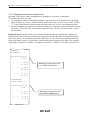
5.5.1 Assignment of penalties or time corrections for phase 1 after the start of phase 2
It often happens that faults for phase 1 have to be assigned after the competitor has started phase 2.
This occurs in particular when a fence is positioned before the photocell for the end of phase 1 and
the start of phase 2.
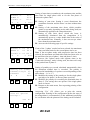
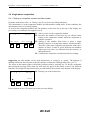
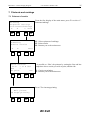
During correction, the display board shows the final time for phase 1 (even if previously it had
already gone on to the displaying of current event time for phase 2). This makes it possible to make
corrections with relative calm.
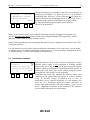
N 1 R 1 F2
TP 0.00 C.T.
Running
Cle Pen. T.C.
F1
5.67
0.00
C.P1→
F2
F3
5.4.4
5.4.4
F4
N 1 R 1 P2
5.67
TP 0.00 T.C. 0.00
Pen.Ph1!
Pen.
T.C. quit
F1
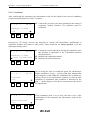
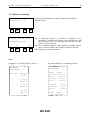
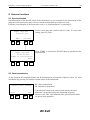
Press F4 (C.F1) to access the function for the assignment of
penalties or time corrections for phase 1.
F2
F3
5.4.4
5.4.4
F4
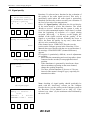
F2. Allows you to assign penalties to the competitor (points
for Table A, seconds for Table C).
F3. Manual correction of competitor’s time.
F4. Returns to the correction mode of phase 2. If a correction
for phase 1 has in fact been made, timing is stopped when
you quit the function (the competitor cannot be admitted
to phase 2).