1
USER INFORMATION
important SAFETY INFORMATION
Operating Instructions
Safety markings are used frequently throughout this
manual to designate a degree or level of seriousness and
should not be ignored. WARNING indicates a potentially
hazardous situation that if not avoided, could result in
personal injury or death. CAUTION indicates a potentially
hazardous situation that if not avoided, may result in minor
or moderate injury or property damage.
Please refer to the thermostat manufacturer’s User manual
for detailed programming instructions.
About the Heat Pump
Your heat pump is a unique, all weather comfort-control
appliance that will heat and cool your home year round
and provide energy saving comfort. It’s an unknown fact
that heat is always in the air, even when the outside
temperature is below freezing. The heat pump uses this
basic law of physics to provide energy saving heat during
the winter months. For example, If the outdoor temperature
is 47° F (8° C), your heat pump can deliver approximately
3.5 units of heat energy per each unit of electrical energy
used, as compared to a maximum of only 1 unit of heat
energy produced with conventional heating systems.
In colder temperatures, the heat pump performs like an air
conditioner run in reverse. Available heat energy outside
the home is absorbed by the refrigerant and exhausted
inside the home. This efficient process means you only
pay for “moving” the heat from the outdoors to the indoor
area. You do not pay to generate the heat, as is the case
with more traditional furnace designs.
During summer, the heat pump reverses the flow of the
heat-absorbing refrigerant to become an energy-efficient,
central air conditioner. Excess heat energy inside the
home is absorbed by the refrigerant and exhausted
outside the home.
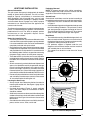
Fan
Mode
System
Mode
Temperature
Selector
Figure 1. Digital Thermostat
2
Cooling Operation
1.Set the thermostat’s system mode to COOL or AUTO
and change the fan mode to AUTO. See Figure 1
2.Set the temperature selector to the desired temperature
level.The outdoor fan, compressor, and blower motor will
all cycle on and off to maintain the indoor temperature
at the desired cooling level.
NOTE: If the temperature level is re-adjusted, or the
system mode is reset, the fan and compressor in the
outdoor unit may not start immediately. A protective
timer circuit holds the compressor and the outdoor fan
off for approximately 5 minutes following a previous
operation or the interruption of the main electrical
power.
Heating Operation
1.Set the thermostat’s system mode to HEAT or AUTO
and change the fan mode to AUTO. See Figure 1.
2.Set the temperature selector to the desired temperature
level. The compressor, outdoor fan, and blower motor
will cycle on and off to maintain the indoor temperature
at the desired heating level.
NOTE: If the temperature level is re-adjusted, or the
system mode is reset, the fan and compressor in the
outdoor unit may not start immediately. A protective
timer circuit holds the compressor and the outdoor fan
off for approximately 5 minutes following a previous
operation or the interruption of the main electrical
power.
Emergency Heat
Some thermostats may include a system mode called EM
HT or AUX HT, etc. This is a back-up heating mode that
should only be used if a problem is suspected. With the
mode set to EM HT, etc., the compressor and outdoor fan
will be locked off and supplemental heat (electric resistance
heating) will be used as a source of heat. Sustained use
of electric resistance heat in place of the heat pump will
result in an increase in electric utility costs.
Defrost Operation
During cold weather heating operation, the outdoor unit
will develop a coating of snow and ice on the heat transfer
coil. This is normal and the unit will defrost itself. This unit
monitors ambient and coil temperatures to regulate the
defrost function accordingly.