1
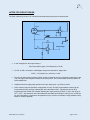
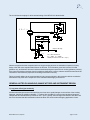
The HCl gas generated vents away from the cell via the capillary, whilst the hydrogen ions (H+) are supplied by
the electrolyte within the cell. The electrons (e-) are supplied by the external circuit via a metal strip in contact
with it, in the form of a small (nA) electric current.
The reaction at the working electrode is balanced by a reciprocal (oxidation) reaction at the ‘counter’ electrode,
using water from the electrolyte:
2H2O → O2 + 4H+ + 4eThe electrons generated in this reaction are removed by the external circuit via a metal strip in contact with the
counter electrode.
Thus when Chlorine is present, water is generated whilst Hydrogen ions are consumed at the working electrode,
whilst the water is re-used and hydrogen ions are generated at the counter electrode. At the same time, the
reaction at the working electrode consumes electrons, whilst the reaction at the counter electrode generates
electrons. By connecting the working and counter electrodes together via a special circuit, the flow of electrons
between the two electrodes may be measured as a nA level current signal proportional to the ppm concentration
of Chlorine.
The ‘reference’ electrode maintains the healthy operation of the cell. It is surrounded by electrolyte, sees no gas
and no current is allowed to be drawn from it. Its electrochemical potential hence always remains constant at a
level known as the “rest air potential” and this is used to regulate the potential of the working electrode,
regardless of the current it is generating during operation. The use of a reference electrode in this way (i.e. threeelectrode operation) helps to extend the working range of the sensor, improves linearity and results in a number
of performance benefits compared with similar sensors working with 2-electrodes only.
FEATURES
Electrochemical gas sensors have the following superiority to conventional semiconductor type and hot-wire type
gas sensors.
•
•
•
•
•
•
•
•
Linear output in proportion to gas concentration
High reproducibility
Highly gas specific
Unaffected by humidity
Stable output for long periods
Low power consumption because no heater is used (can be battery operated)
Small and lightweight (can be used in portable devices)
No mechanical structure so highly resistant to shocks and vibrations.
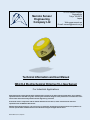
The NE4-CL2 has been developed from our accumulation of technologies in production of hot-wire type gas
sensors, long research experience into catalysts, fine printing, and assembling of sensors. The NE4-CL2 is
small and less-expensive, but has high sensitivity, long life, and leak-free performance even under severe
operating conditions.
Air vent
The electrolyte used for chemical sensors is very hygroscopic, i.e. it has affinity for water, and its volume varies
depending on ambient temperature and humidity. This variation causes pressure inside the sensor to rise and
fall. In the worst case the electrolyte may leak out of the sensor and damage the circuitry around it.
To prevent this, the NE4-CL2 utilizes an air vent capability. This maintains equilibrium between internal and
external pressures and allows the sensor to be used in any orientation and under high temperature and humidity
conditions.
NE4-CL2-Manual, Issue 4, Sept 2015
- page 3 of 15 -