1
Applications
Keyword
Inpu
Input/Output
IInp
np
npu
pu
Efficiency Measurements of Inverter Motors
fo
for
orr Hybrid Electric Vehicles (HEV), Electric Vehicles (EV),
and Plug-in Hybrid Electric Vehicles (PHEV)
*Also refer to the features of other applications.
applications
Inve
In
vert
rter
terr sec
e tiion
on
M tor
Mo
Inpu
In
p t
pu
Booster
Converter
section
Batteriess
Torque/
rotation
sensor
Load
Drive circuit
1
2
Overview
Modulate and convert DC to AC signals
3 4 5
M
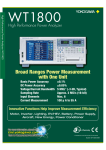
The WT1800’s ability to perform up to 6 power input measurements makes it possible to evaluate the battery’s charge and discharge characteristics, and test and evaluate the
efficiency between the input and output of inverters. A motor evaluation function (/MTR option) makes it possible to simultaneously monitor changes in the voltage, current, and
power, as well as changes in the rotation speed and torque.
Advantages of WT1800
n Harmonic measurements from a 0.5 Hz low frequency
(/G5 and /G6 options)
In motor testing, evaluation is performed at
various rotation speeds from low to high speeds.
The WT1800 supports the lower limit frequency
of 0.5 Hz to make it possible to measure
harmonics at a very low motor rotation speed
without using an external sampling clock.
Harmonic
measurements
from 0.5 Hz
n Inverter, motor, and DC/DC converter efficiency
measurements
A single WT1800 unit is capable of measuring the effective power, frequency, and motor
output in order to measure the total efficiency, including inverter and motor efficiency and
battery DC/DC conversion efficiency.
DC power accuracy has been improved to ±0.05% to ensure more accurate measurements.
n Battery charge and discharge measurements
In integrated measurement, the battery charge and discharge can be evaluated.
Instantaneous positive and negative values captured at an approximately 2 MS/s high-speed
sampling rate are integrated, respectively, and each of the total values is displayed.
Battery
charge/discharge
Inverter/motor
efficiency
measurements
Approx. 2 MS/s
high-speed
sampling
DC power ±0.05%
AC power±0.1%
Typical repetitive high-speed charging and
discharging signals
Effective power
amount (Wh+)
Charge
Effective power
amount (Wh-)
Discharge
Charge current amount Ah (power amount Wh) and discharge
current amount Ah (power amount Wh) can be integrated, respectively.
n Offset correction measurement by null function
Null
Individual
offset adjustment
After you finish connecting the wires for inverter motor testing,
you may find a value will not become zero due to the influence of
the ambient environment or other reasons and the offset value
will be applied inappropriately even before starting
measurements.
With the previous power analyzer model*, there is no choice
other than to turn all inputs on and off collectively, so unintended
offset adjustment is performed even for inputs for which you do
not want adjust.
With the WT1800, only an input for which you want to perform
offset adjustment can be turned on and off.
n DA output and remote control (/DA option)
20-channel
output
Integration by
remote control
Sometimes you may want to check changes in data, along with
other measurement data (temperature, etc) at the same time
when you acquire communication data, such as voltage, current,
power, and efficiency data. A DA output function allows you to
retrieve analog signals on up to 20 channels.
Also, remote control signals make it possible to control the start,
stop, and reset of integration by external analog signals.
Furthermore, integration can be linked by inputting an analog
trigger signal from another device.
*Comparison with Yokogawa’s previous model WT1600
10
Typical Product Configuration
*For detailed specifications, see the page on the specifications. You need to provide a cable for voltage measurements when wiring.
WT1805-50-H-HE/B5/G6/DT/DA/MTR: 5 power inputs, current input range 100 μA to 5.5 A (measuring AC/DC current sensor output), built-in printer, dual harmonic, delta computation, DA output, motor
evaluation function