1
TECH FLASH
Hank Hogan • contributing editor • hank@hankhogan.com
Get in Touch With HMIs and Machines
Machine-to-machine communication might ben-
Behind the scenes, the use of OPC UA means that
efit from the right touch—specifically the right multi-
the devices can exchange data with other machines.
touch input displays. Along with the ability of modern
Beckhoff’s products can be either the client or the
HMIs to remotely collect data, the technology could
server without hardware add-ons. Thus, they can do
give control engineers new tools and capabilities.
machine-to-machine communication with other sys-
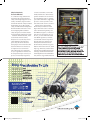
An example of how this might unfold comes from
tems on the plant floor. Beyond that, they can also talk
Lenze (www.lenze.com). The automation supplier an-
to management systems and move data from shop
nounced a panel controller a year ago that features an
floor to top floor and vice versa, according to Eisel.
ARM processor, Ethernet connectivity, a USB port and
a resistive touch display.
Importantly, its operating system is Windows, and
Looking forward, he sees two trends. One is unification of HMI and controllers into a single unit that talks
both upstream and downstream, interacting with ma-
that brings a host of features, explains Lenze’s tech-
chines and management systems. The other is a change
nology evangelist Tom Jensen. These include the abil-
in the input and display systems. For example, Beckhoff
ity to easily pass information around and the power
Automation has studied the use of Google Glass, which
to graphically display it, leading to some interesting
integrates a heads-up display with a camera, in an
usage scenarios.
industrial environment. The technology could indicate
“If I have one HMI and two machines, when one
machine burps, the HMI will notice and automatically
ask, ‘Hey, do you want videos to help troubleshoot this
other machine? Yes or no?’” Jensen explains.
The two machines operating under such unified
control could be an application, such as a filler-capper
combination, which are used in pharmaceutical or
beverage processing. These devices might process
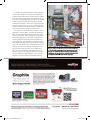
things to come—the birth of a wearable HMI.
M
achine-to-machine communication and
a modern, touch-enabled device means
there’s no need to stand around an HMI
to diagnose and solve a problem.
HMIs today are the main point of decision-making
250 units per minute for pharmaceutical operations
for operators, and this will continue in the future,
and as many as 1,200 per minute in the case of bever-
notes John Dirks, global product manager for Rockwell
ages, according to Jensen.
Automation’s (www.rockwellautomation.com) Panel-
In part, this new approach that could involve troubleshooting videos is now possible because the devices
have the computing horsepower to oversee several
View Plus. The product family has panel sizes as small
as four inches, with a 19-in. display planned.
In Spring 2013, the company announced a new ver-
multi-axis motion operations simultaneously. They also
sion of HMI software. It allows its panels to connect to
can handle the data load associated with a high volume
and display data from noncontrollers such as power
of manufacturing throughput. Software running on the
monitors or smart overload relays.
devices also can react to defined conditions, such as an
As time goes by, the computers behind the panels
alarm, a changeover request or a need for maintenance.
will produce a wider array of data and will interface
In those cases, a video could pop up and guide person-
with more systems on and off the plant floor. Some of
nel through the appropriate actions to take.
this data will be accessed remotely. For instance, the
Some of Beckhoff Automation’s (www.beckhoff.com)
manager of a beverage plant might need to access a
industrial display families have multi-point projective
screen showing a key performance indicator of a bottle-
capacitive input. This means that swiping, flicking,
filling machine. That can be done by connecting to the
zooming and other operations found on consumer
filling room HMI and extracting the data. This sort of
devices are possible. That familiarity brings benefits.
machine-to-machine communication and a modern,
“It’s much easier for training in an international
touch-enabled device mean there’s no need for person-
market to get operators to understand a machine and
nel to stand at an HMI to diagnose and solve a problem.
navigate the different HMI screens more efficiently,”
As Dirks says, “The support person, be they mainte-
says Nathan Eisel, Beckhoff’s North America support
nance, operations or an engineer, can connect into the
manager. He adds that the input technology can be
terminal, see exactly what’s going on and be able to
used with thin gloves on, unlike some other multi-
walk an operator through some troubleshooting steps
touch technologies.
without having to come out on the floor.”
controldesign.com CD1405_43_TECHFLASH.indd 43
May 2014 Control Design
43
5/12/14 4:32 PM