1
2.
Remove faulty battery and dispose of properly.
3.
Observing correct polarity (negative side of the battery
facing the trigger), insert the battery into the battery
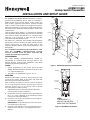
holder as shown in Figure 1.
4.
Reinstall two cover screws and two mounting screws as
shown in Figure 1.
SPECIFICATIONS
MOUNTING
HOLE
Physical
1-15/16"W x 5-15/16"H x 1-3/16"D
(50mm x 150mm x 30mm)
+
MOUNTING
HOLE
+
Battery
3-volt Lithium. ADEMCO 466, Duracell
DL123A, Panasonic CR123A, Varta CR123A.
Frequency
345MHz
Reset Key:
Supplied, Part Number K4563 to order
separately
Agency:
UL 636 – Holdup alarm units and systems
BREAKAWAY
TAMPER
SCREW
No. 6X3/4
COVER
SCREW (2)
No. 6x1/2
COVER
SCREW (2)
No. 6x1/2
MOUNTING
SCREW (2)
No. 6X2
5869-004-V0
MOUNTING
SCREW (2)
No. 6X2
IMPORTANT:
THIS DEVICE MUST BE PERMANENTLY
MOUNTED WITH THE SCREWS SUPPLIED.
Figure 3. Typical Holdup Switch Installation
BATTERY REPLACEMENT
BATTERY CAUTION:
Risk of fire, explosion, and burns. Do not recharge, disassemble, heat above 100°C, or incinerate. Dispose of used
batteries promptly and properly. Keep away from children.
C
US
LISTED
IMPORTANT: When servicing the device for battery
replacement, note that with the mounting screws
removed the case is held in place by the tamper release
tab. Exercise caution not to jar the case while replacing
the battery, possibly breaking the Tamper breakaway
tab.
1.
R
Remove the two screws securing the cover and two
mounting screws as shown in figure 1.
NOTE: Use care not to bend the antenna while
attempting to remove or install the battery.
TO THE INSTALLER
Regular maintenance and inspection (at least annually) by the installer and frequent testing by the user are
vital to continuous satisfactory operation of any alarm system.
The installer should assume the responsibility of developing and offering a regular maintenance program to
the user, as well as acquainting the user with the proper operation and limitations of the alarm system and its
component parts. Recommendations must be included for a specific program of frequent testing (at least
weekly) to insure the system's operation at all times.
-2-