1
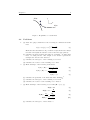
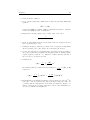
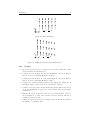
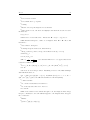
Chapter 2 7 1 1 1 0.5 0.5 y0 y0 –0.5 –0.5 –1 0.5 y0 –0.5 –1 –1 –1 –0.5 0 x 0.5 1 –1 –0.5 0 x 0.5 1 –1 –0.5 0 x 0.5 1 Figure 4: Field for n = 0.1, n = 0.5 and n = 1 (b) Calculate the divergence of this field. Is there an n for which ∇ · B = 0? Answer: For the divergence we have to calculate ∇·B = So let’s start with ∂By ∂Bx + ∂x ∂y ∂Bx ∂x ∂ ∂Bx = ∂x ∂x −y −y 2 (x + y 2 )n ) = ∂ 2 (x + y 2 )−n = −y · −n(x2 + y 2 )−n−1 · 2x = ∂x 2nxy (x2 + y 2 )n+1 Similarly, we get for x ∂By ∂y ∂ 2 (x + y 2 )−n = x · −n(x2 + y 2 )−n−1 · 2y = ∂y −2nxy (x2 + y 2 )n+1 The sum is zero! Hi, hi, the divergence is zero everywhere... (c) Calculate the rotation of the field. What is the direction of the rotation of field (1)? Is there an n for which ∇ × B = 0? Answer: The rotation of the field is a vector: ∂By ∂Bz ∂y − ∂z ∂Bz x rotB = ∇ × B = ∂B ∂z − ∂x ∂By ∂Bx ∂x − ∂y Since this is a twodimensional field in the (x, y) plane, both Bz and the partial derivatives to z are zero. So the rotation will only have a z component. Just like above we have to calculate two derivatives. ∇×B = ∂Bx ∂By − ∂x ∂y ez =