1
Keil FR166 RTOS and CAN Libraries
Keil Software produces two versions of a Real Time Operating System. The FR166 is a multitasking real-time
operating system for the Siemens 166/167 family. You can manage multiple tasks on a single CPU making your
programs much easier to develop. The RTX166 Full includes CAN libraries. The RTX166 Tiny is a subset of the
RTX166 Full and is included with all Keil 166 C Compiler Kits.
Functional Description of the Example Programs
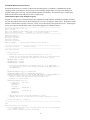
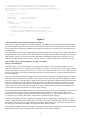
Program A_CANX1 keeps a transmit message object updated; the CAN controller automatically transmits it without
any CPU intervention when a remote frame requesting it is received. See Figure 2 for the source. Program B_CANX1
transmits a remote frame requesting a message, waits to receive the message, then repeats the process. Each program
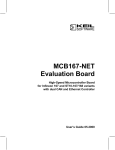
runs on one of the two Keil MCB167 boards. Recall these programs are available from Keil.
/******************************************************************************
C167CR CAN Application Note 119
Main - a_canx1
This is an example program showing how to use the CAN interface on the Keil
MCB167 evaluation board.
Copyright (c) 1997 Keil Software
******************************************************************************/
#include <stdio.h>
#include <intrins.h>
#include "can_ifc.h"
#include "timer.h"
#include "can_msgs.h"
#define TIME_MO 1 /* message object number for time message */
/******************************************************************************
Setup CAN controller
Returns: nothing
-----------------------------------------------------------------------------*/
void setup_can(void)
{
begin_can_init();
/* These mask values tell the CAN controller that all bits in a
message id. are significant when comparing the id of a received message
to the id's in the arbitration registers of the message objects.
*/
CAN_MASK_SHORT = 0xffff;
CAN_UMASK_LONG = 0xffff;
CAN_LMASK_LONG = 0xf8ff;
/* Since this program doesn't use message object 15, it is unnecessary
to initialize the 'mask of last message' registers (CAN_UMASK_LAST and
CAN_LMASK_LAST).
*/
CAN_MSGOBJ[TIME_MO].msg_ctl = MSGVAL_CLR;
CAN_MSGOBJ[TIME_MO].arbitr = ARBITR(CAN_TIME_MSG);
CAN_MSGOBJ[TIME_MO].msg_cfg = MSG_CFG(LEN_CAN_TIME_MSG, CANDIR_TRANSMIT, 0);
/* We're not initializing the data field right now, so we set
CPUUPD to prevent the message from being transmitted in
response to a remote frame.
*/
CAN_MSGOBJ[TIME_MO].msg_ctl =
/* clear bits
set bits */
INTPND_CLR &
RXIE_CLR &
TXIE_CLR &
MSGVAL_SET &
NEWDAT_CLR &
CPUUPD_SET &
TXRQ_CLR &
RMTPND_CLR;
/* CAN_IE_ must be set for any CAN interrupts to occur.
CAN_EIE_ must be set for CAN error status change interrupts to occur.
*/
end_can_init(CAN_IE_ | CAN_EIE_);
}
/******************************************************************************
main
This program does the following:
Set up the CAN controller, with a message object for the time stamp message
as a transmit object.
Setup a timer to generate periodic interrupts.
2