1
INTRODUCTION
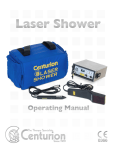
You have just purchased the most user friendly and up to date veterinary laser therapy technology available:
the Centurion Laser Shower. Congratulations on your selection!
The Centurion Laser Shower operates by emitting laser light in a continuous shower at multiple frequencies.
A 785 NM wavelength has been incorporated into the Laser Shower in response to research showing the
most effective penetration of laser light. The effective average power directed toward an injured area is
increased through multiple frequency targeting and the use of aluminium Galion Arsonite continuous wave
laser diodes. The shower effect allows for the treatment of many diverse indications, ranging from surface
injuries to deep-seated soft tissue injuries. Correct frequency selection, as is required by older style units, is
not required in the operation of the Centurion Laser Shower.
EFFECTS OF LASER LIGHT ON TISSUE
Understanding the five primary actions of laser light on tissue is helpful for proper use of the Centurion
Laser Shower.
1. ACCELERATED TISSUE REPAIR
The action of laser light is quite similar to photosynthesis, where plants manufacture food from carbon
dioxide and water, using light energy to achieve chemical energy. Photons of light from a laser penetrate
deeply into tissue and power the synthesis of adenosine triphosphate (ATP). In other words, photons of
light energy are converted to chemical energy at the cell membrane. ATP acts as a major carrier of energy
from one reaction site to another in all living cells. Increases in ATP resulting from laser light stimulation
increases the energy available to the cell so that the cell can metabolize more quickly. Nutrients can be
taken in and waste products eliminated at a higher rate. The result is an acceleration of repair to the cells
comprising tendons, and ligaments (connective tissue) with exposure to laser light.
2. RAPID FORMATION OF COLLAGEN
Approximately 80% of a horse's body is comprised of collagen. This essential fibrous protein is required to
replace old tissue or to repair tissue injuries. The most common example of collagen is the clear sticky
substance found around open wounds. The fibroblast cells found in connective tissue consume "extra"
energy provided by laser light to increase collagen production. Wounds are repaired or closed over rapidly,
and less scar tissue is formed, with the correct application of laser light.