1
28
P. PRUSINKIEWICZ ET AL.
language has been surveyed by Prusinkiewicz (1999), with subsequent additions (in
particular, decomposition and interpretation rules) described by Prusinkiewicz et al.
(2000). The currently available constructs have been listed by MČch et al. (2005).
The language of the lpfg simulator was designed more recently (Karwowski 2002;
Karwowski and Prusinkiewicz 2003; Karwowski and Lane 2006) to facilitate the
specification of complex plant models (e.g. Mündermann et al. 2005; Allen et al.
2005). We call this language L+C, because it combines features of L-systems and
the C++ programming language. Here we overview key features of L+C in a manner
that complements and updates its earlier presentation by Karwowski and
Prusinkiewicz (2003), and we illustrate the discussed features in the context of a
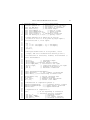
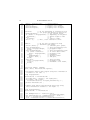
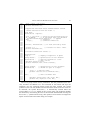
complete L+C program: a model of a growing branch that bends due to gravity.
FAST INFORMATION TRANSFER
An essential component of functional-structural plant models is transport of
information through the organism (Perttunen et al. 1996; Allen et al. 2005). A
simple L-system example would be assigning consecutive numbers to a sequence of
modules in a string. This task can be accomplished using the context-sensitive
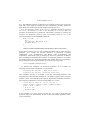
production B(m) < A(n) Æ B(m+1), as illustrated below for a string of N=4
modules:
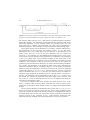
We observe that it takes N–1 derivation steps for the information to propagate to the
end of an N-element string, as indicated by the arrows. This is a consequence of
determining the next state of each module as a function of the current state of its left
neighbour. Although each module in the string is rewritten in each derivation step,
the state of only one module is changed. The remaining modules are not affected.
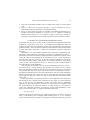
L+C includes a construct that makes it possible to accelerate this information
transfer if the string is rewritten sequentially, from left to right, during a single
derivation step. Under this assumption, the next state of a module can be calculated
as a function of the (just calculated) next state of its left neighbour, rather than the
current state of that neighbour. The flow of information is then represented by the
arrows in the following derivation step: