1
PQA600A Datasheet
System evaluation
Prediction of human vision perception
The PQA can be used for installation, verification, and troubleshooting of
each block of the video system because it is video technology agnostic: any
visible differences between video input and output from processing
components in the system chain can be quantified and assessed for video
quality degradation. Not only can CODEC technologies be assessed in a
system, but any process that has potential for visible differences can also
be assessed.
PQA measurements are developed from the human vision system model
and additional algorithms have been added to improve upon the model
used in the PQA200/300. This new extended technology allows legacy
PQR measurements for SD while enabling predictions of subjective quality
rating of video for a variety of video formats (HD, SD, CIF, etc.). It takes
into consideration different display types used to view the video (for
example, interlaced or progressive and CRT or LCD) and different viewing
conditions (for example, room lighting and viewing distance).
For example, digital transmission errors, format conversion (i.e. 1080i to
480p in set-top box conversions), analog transmission degradation, data
errors, slow display response times, frame rate reduction (for mobile
transmission and videophone teleconferencing), and more can all be
evaluated.
Picture quality analysis system
A model of the human vision system has been developed to predict the
response to light stimulus with respect to the following parameters:
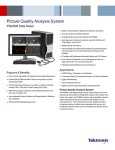
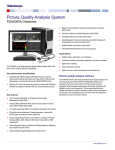
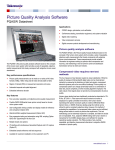
User interface of PQA showing reference, test sequences, with difference map and
statistical graph.
How it works
The PQA takes two video files as inputs: a reference video sequence and a
compressed, impaired, or processed version of the reference. First, the
PQA performs a spatial and temporal alignment between the two
sequences, without the need for a calibration stripe embedded within the
video sequence. Then the PQA analyzes the quality of the test video, using
measurements based on the human vision system and attention models,
and then outputs quality measurements that are highly correlated with
subjective assessments.
The results include overall quality summary metrics, frame-by-frame
measurement metrics, and an impairment map for each frame. The PQA
also provides traditional picture quality measures such as PSNR (Peak
Signal-to-Noise Ratio) as an industry benchmark impairment diagnosis tool
for measuring typical video impairments and detecting artifacts.
Each reference video sequence and test clip can have different resolutions
and frame rates. This capability supports a variety of repurposing
applications such as format conversion, DVD authoring, IP broadcasting,
and semiconductor design. The PQA can also support measurement clips
with long sequence duration, allowing a video clip to be quantified for
picture quality through various conversion processes.
2 www.tektronix.com
Contrast including supra-threshold
Mean luminance
Spatial frequency
Temporal frequency
Angular extent
Temporal extent
Surround
Eccentricity
Orientation
Adaptation effects