1
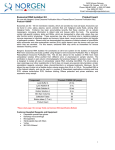
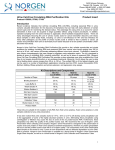
Important Notes Working with RNA RNases are very stable and robust enzymes that degrade RNA. Autoclaving solutions and glassware is not always sufficient to actively remove these enzymes. The first step when preparing to work with RNA is to create an RNase-free environment. The following precautions are recommended as your best defence against these enzymes. The RNA area should be located away from microbiological work stations Clean, disposable gloves should be worn at all times when handling reagents, samples, pipettes, disposable tubes, etc. It is recommended that gloves are changed frequently to avoid contamination There should be designated solutions, tips, tubes, lab coats, pipettes, etc. for RNA only All RNA solutions should be prepared using at least 0.05% DEPC-treated autoclaved water or molecular biology grade nuclease-free water Clean all surfaces with commercially available RNase decontamination solutions When working with purified RNA, ensure that they remain on ice during downstream applications Notes Prior to Use All centrifugation steps are performed at room temperature. Ensure that centrifuge tubes used are capable of withstanding the centrifugal forces required. The provided spin columns are optimized to be used with a benchtop centrifuges and not to be used on a vacuum apparatus Most standard benchtop microcentrifuges will accommodate Norgen's Mini Spin Columns. Centrifuging Norgen's Spin Columns at a speed higher than recommended may affect RNA yield. Centrifuging Norgen's Spin Columns at a speed lower than recommended will not affect RNA yield. However, centrifugation at a lower speed may require longer time for the solutions to pass through the spin column Ensure that all solutions are at room temperature prior to use. o It is highly recommended to warm up Lysis Buffer A at 60 C for 20 minutes and mix well until the solutions become clear again if precipitates are present. Prepare a working concentration of the Wash Solution A by adding 42 mL of 96 - 100% ethanol (provided by the user) to the supplied bottles containing 18 mL of concentrated Wash Solution A. This will give a final volume of 60 mL. The labels on the bottles have a box that may be checked to indicate that the ethanol has been added. If any of the solutions do not go through the Spin Columns within the specified centrifugation time, spin for an additional 1-2 minutes until the solution completely passes through the Column. Do NOT exceed the centrifugation speed as this may affect RNA yield. Preparation of Cell-free Plasma/Serum from Frozen Sample o 1. Place your frozen Plasma/Serum at 4 C to thaw. 2. After thawing your plasma/serum sample, aliquot the volume to be processed and centrifuge for 2 minutes at 400 x g (~2,000 RPM). 3. After centrifugation, transfer the clear plasma/serum supernatant to a fresh tube Cell-Free Plasma/Serum is now ready for Exosomes purification. Section 1: Exosome Purification from 50 µL - 1 mL Cell-Free Plasma/Serum Note: The procedure outlined below is for 1 mL input of plasma/serum. If processing a sample volume lower than 1 mL plasma/serum, simply bring the volume of your samples up to 1 mL using Nuclease-free water and proceed as outlined below. 1. 2. 3. 4. To 1 mL plasma/serum add 3 mL Nuclease-free water followed by the addition of 100 µL of ExoC Buffer. (Note: The final volume of any plasma/serum sample to be processed should be 4 mL before the addition of the specified 100 µL of ExoC Buffer) To the mixture from Step 1 add 200 µL of Slurry E. Mix well by vortexing for 10 seconds and let stand at room temperature for 5 minutes. (Note: Mix Slurry E well prior to use. For optimal performance ensure that resin is completely resuspended). Mix well by vortexing for 10 seconds. Centrifuge for 2 minutes at 2,000 RPM. Discard the supernatant. Apply 200 µL ExoR Buffer to the slurry pellet and mix well by vortexing for 10 seconds. 3