1
3.1.4
Principal Characteristics of the ZARM Drop Tower
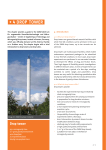
The ZARM drop tower is a 146 m tall concrete shaft (Figure 3-1), which provides near weightlessness up to 3
times a day, for experiments dropped from the top of the tower (4.74 seconds of microgravity) or catapulted
upwards from below the tower (9.48 seconds), respectively. In September 2004, a catapult system was
inaugurated at the ZARM drop tower (Figure 3-2), which doubles the standard drop microgravity time, and is
located in a chamber 11 m below ground under the tower. This catapult throws the capsule upwards from the
bottom of the tower, accelerating it by a pneumatic piston driven by the pressure difference between the vacuum
inside the drop tube and the pressure inside the tanks. The acceleration level is adjusted by means of a servo
hydraulic braking system controlling the piston velocity. This catapult system accelerates capsule masses from
300 kg up to 500 kg to a speed of 48 m/s within 0.28 seconds.
The microgravity lab system itself is a cylindrical capsule with a diameter of 800 mm and a length of 1.6 m or 2.4
m depending on the space required. Inserted platforms, held in aluminium frames, form the modular drop capsule
structure. After integration of an experiment prior to a drop or a launch, the whole capsule is closed pressure-tight
with an aluminium cover. When performing a drop, a winch pulls up the capsule to the maximum internal height
of 120 m. The specially designed release mechanism serves for low induction of disturbances during free fall. The
internal drop tube is evacuated before every drop or launch and the capsule is released/catapulted at a residual
pressure of 10 Pa. The internal tube, which has a volume of 1700 m3, stands detached at a height of 13 m on the 2
m thick roof of the deceleration chamber. The detachment of the tube from the tower itself is necessary to assure
quiescent conditions even during stormy weather. During the free fall period of a drop or launch, an ultimate
microgravity quality with residual accelerations less than 10-5g can be detected. At the end of the experiment, an 8
m high deceleration unit, filled with polystyrene pellets, decelerates the vehicle.
Figure 3-1: ZARM Drop Tower External View
DROP TOWER
page 3-2