1
QUI-0003
Page 3
1. Introduction to the TC-20
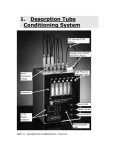
The TC-20™ may be used as a sorbent tube conditioning rig (to clean sorbent tubes prior to sampling) or
as a dry-purge rig (to remove water from sampled tubes prior to analysis).
1.1
Tube conditioning
It is essential that tubes are carefully conditioned before they are used for sample collection. Conditioning
parameters should be more stringent than those to be used for subsequent analysis. Typically, tubes are
conditioned at 10°C below the maximum safe temperature of the least stable sorbent in the tube. Extra
care should be taken when conditioning carbonised molecular sieve-type sorbents to ensure that all
oxygen is eliminated from the tube before sorbent temperatures are allowed to exceed 250°C.
More details of recommended tube conditioning parameters are given in Application Notes TDTS 5 and
TDTS 19 (available at www.markes.com).
After conditioning, a representative number of the cleaned tubes (usually 1 in 10) should be desorbed
under analytical conditions to check artefact levels. Individual artefacts (peaks on the blank
chromatogram) should be no more than 1 ng in toluene equivalents for Tenax® and below 10 ng toluene
equivalents for other porous polymer sorbents. Artefact levels can be reduced to below 0.1 ng after
stringent conditioning for most carbon sorbents.
NOTE: It is advisable to keep a record of blank chromatograms for individual tubes or series of tubes, so
that trends in artefact levels can be monitored.
1.2
Dry-purging
Dry-purging is used to remove excess water from sorbent tubes, particularly when hydrophilic sorbents
such as Carboxen™ 1000 and Carbosieve™ SIII have been used.
After sampling, clean, dry carrier gas is passed through the tube in the sampling direction (i.e. with gas
arriving at the grooved end of the tube first).
For example, if mixed-bed universal tubes (which contain Tenax®, a graphitised carbon black and a
carbonised molecular sieve), are purged in this direction at a flow rate of approximately 50 mL/min for
10–20 min, the level of water found on the tube is significantly reduced. This helps to avoid potential
difficulties with GC detectors such as mass selective detectors, FIDs and ECDs, where a large amount of
water can adversely affect the detector. In addition to this, it extends the column lifetime.
Markes International Ltd
T: +44 (0)1443 230935 F: +44 (0)1443 231531 E: enquiries@markes.com
www.markes.com