1
Therapy, modes and features
What are the therapy modes?
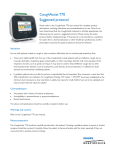
CoughAssist T70 offers both Manual and Auto therapy modes.
Therapy mode
Description
Manual
Manual mode delivers therapy based on the Inhale Pressure and Exhale Pressure prescription
settings. The device delivers the set inhalation pressure for the amount of time that the Manual
switch is held in the inhalation position. The device delivers the set exhalation pressure for the
amount of time that the Manual switch is held in the exhalation position. Therapy starts in the
Pause phase when activated in Manual mode.
Auto
Auto mode delivers therapy based on the following prescription settings: Inhale Pressure,
Exhale Pressure, Inhale Time, Exhale Time, and Pause Time. Auto mode delivers pressure in the
following sequence, repeating the sequence until the user exits the therapy state:
1. Positive pressure at the Inhale Pressure setting for the duration of the Inhale Time setting.
2. Negative pressure at the Exhale Pressure setting for the duration of the Exhale Time setting.
3. Atmospheric pressure for the duration of the Pause Time setting.
When the Cough-Trak feature is enabled, Auto mode delivers pressure in the following
sequence, repeating the sequence until the user exits the therapy state:
1. Positive pressure at the Inhale Pressure setting when the device detects the patient’s effort to
inhale for the duration of the Inhale Time setting.
2. Negative pressure at the Exhale Pressure setting for the duration of the Exhale Time setting.
3. Atmospheric pressure until the device detects the next inspiratory effort.
What is Cough-Trak?
Cough-Trak is a feature that triggers the device on the patient’s inspiratory effort to synchronize with the
user’s breathing pattern. Therapy will start when the patient’s effort is detected.
What is the sensitivity of Cough-Trak (compared to Auto-Trak or other triggers)?
Cough-Trak was designed to facilitate patient synchrony while avoiding false triggers. Example: putting on the
mask does not cause a false trigger. For a typical patient (adult or pediatric), modest breathing effort with a
patient muscle effort of 2.5 cm H2O to 3 cm H2O or greater, are sufficient to trigger a cough sequence.
Can we recommend Cough-Trak for use on children?
Yes. Cough-Trak may be used on children.
Can you measure saturation levels during a treatment?
No. Saturation levels can only be measured before and after the treatment.
What is a good peak cough flow?
Retrospective data suggests that a peak cough flow of 160 l/min may be required to clear the lung adequately.
Bach JR. Amyotrophic lateral sclerosis: predictors for prolongation of life by respiratory aids. Arch Phys Med Rehabil
1995; 76:828-32.
Page 2