1
AUSTRALIAN DIRECT - BATTERIES & CHARGING GUIDE
BATTERIES
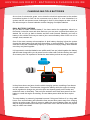
A QUICK LOOK AT HOW A BATTERY WORKS
So that we can better understand battery charging let’s have a quick look at how a
battery is made and what happens inside a battery.
HYDROGEN
H 2 S0 4
H2 0
H2 0
LEAD OXIDE
OXYGEN
H 2 S0 4
LEAD
LEAD OXIDE
DISCHARGED
LEAD
CHARGED
In very simple terms a vehicle battery is made up of a series of cells (usually 6 x 2V
cells) and in each cell there are two sets of plates suspended in electrolyte. In each
cell, one set of plates is made of lead and the other set is made from lead oxide. These
plates are separated and suspended in an electrolyte (typically water or H2O) containing sulphuric acid.
When a battery is fully charged the sulphuric acid is at its strongest and the electrolyte has
a very high specific gravity. Once an electrical load is placed on the battery a chemical
reaction occurs whereby the acid is broken down from the electrolyte and some of its
elements move into the lead plates oxidising the plates. Heavily discharged batteries can
actually sulphate the negative plates making them difficult to receive charge when we try
to reverse the process.
As a result of this internal chemical process electrons are released to flow between
the two plates. A fully discharged battery has very little acid left in the electrolyte and
therefore has a very low specific gravity.
Thankfully a vehicle’s battery can be recharged and this process can be reversed. It
is also worth noting that during recharging, hydrogen and oxygen gases are released,
which is why we need to top up flooded batteries from time to time. Oh…and it’s why you
should never have a naked flame near a battery!
The thickness of the plates within the battery determines a lot about a battery’s intended
use. Thin plates are quite porous and release a lot of energy very quickly, which is ideal
for cranking batteries. Deep cycle batteries on the other hand have much thicker and
denser plates so they provide a much slower and longer discharge. This is also a reason
why some deep cycle batteries do not like to be used as cranking batteries.
1