1
BT RULES WHITE PAPER
13
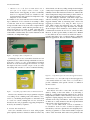
multiple devices into a single sequential script, implicitly
defining messaging relationships between them.
Figure 16.
Combining RSS and Twitter in a single seamless script
Type-safe variables can be created permitting devices to
seamlessly share data within a script. Users’ dissatisfaction
with implicit end blocks has been met by graphically bracketing event handling scripts in a consistent way with other code
blocks, equivalent to curly brackets in C style languages.
Experimental systems controlled by BT Rules in private
testing in the labs include Retail banking systems, Nokia
mobile phones running Symbian 60, X10 home automation
tools[21] and Windows desktops. A run immediately event
has been implemented for users who want to take advantage
of the authoring framework to create one-shot operations. A
prototype simulation layer exists which allows users to execute
the scripts they author in an imperatively controlled artificial
world and verify that the logic they have defined is indeed as
they expect.
IX. F UTURE W ORK
I only understood what to do after I finished the first
sequence
As explored in this paper, BT Rules offers an extremely userfriendly interface for both programmers and non-programmers
to manage their digital devices, but users still desire guidance
when creating new behaviours. A wide selection of potential
devices to program or a blank IDE screen can be daunting for
the users and they will look to the BT Rules infrastructure for
inspiration and support.
We can respond to users’ requests for language guidance in
two ways, firstly by providing easily encountered illustrative
examples, and secondly by hosting a community who can
construct examples which are relevant to their own lifestyles
and facilitate the sharing of examples between peers.
By providing example behaviours which are easy to find,
understand and use, we eliminate one of the key hurdles to
users wishing to use the system. Rather than having to build a
script from scratch, they may choose a pre-existing one from
a repository which they can edit to achieve the behaviour they
desire. The pre-defined scripts bring the benefits of:
• illustrating the techniques and structures used in BT Rules
• demonstrating the capabilities of the language
• providing inspiration for the user’s own scripts
• encouraging the uptake of new devices, software or
services
Once a suitable repository of example scripts is in place, and
users are familiar with adapting them for their own use, it is a
logical progression to move to a community where users may
share their scripts amongst each other. We intend to build a
rich framework to allow this community to grow organically
around the capabilities of the system. Users will be given a
variety of tools to allow them not only to share scripts to
the community and to adopt other scripts but to also share
knowledge and best practice through code fragments, design
patterns and annotations and comments on specific language
tiles.
Through the use of a single hosting platform for the scripts,
histories and ancestry trees may be maintained allowing users
to examine the origins, and future reuse of their scripts, further
enhancing their ability to contribute to the community, through
inspiring others’ creations and learning from reuse of their
own. We expect ad-hoc communities may emerge around
groups of scripts rather than formally defined projects, as is
common in traditional Open Source communities.
An area which will be examined in depth is that of ‘unusable
tiles’. This can take two forms and both could drive interesting
user behaviours. Firstly, the facilities will be provided to
enable a user to build a script for a device which they do
not yet own. A user may not have an iPhone, but may choose
to develop a behaviour which includes the iPhone as one of the
devices. This enables them to experiment with the possibilities
of the device without the investment to buy one. We envisage
this may drive higher uptake of some devices if users are able
to appreciate their capabilities before purchase.
Conversely, it may be possible to give users the ability to
suggest definitions of tiles themselves, where the behaviour
does not yet exist. They may suggest, for example, capabilities
or even full devices which they would like to be able to control,
which could then be evaluated by the developer community as
to whether they are feasible and desirable to implement. A key
challenge with this approach will be to develop a suggestion
system which does not become overrun by users requesting
duplicate functionality, behaviour they could define themselves
in a script, or small variations on existing functions.
We intend to investigate in depth the process a user goes
through in creating a script, from inception through to the
deployment and ‘debugging’ stages. Through the collaborative
website hosting the users’ scripts, we can examine and track
a script’s history, allowing in-depth analysis of the users’ cognitive processes and design decisions. We intend to examine
the choices of code reuse (from the community, from a user’s
own existing scripts of from pre-made examples); the style of
use (many or few scripts, simple or complex behaviours) and
the level of interaction between users in the community.
A key area we wish to address in the future is methods to
convey to users the operation of their scripts and behaviours
without them actually running. This becomes increasingly
important as chargeable services, such as SMS messaging, are
introduced, where a mistake by a user could result in them receiving a large and unexpected bill. We will investigate various
approaches to simulate the user’s ‘world’ and to illustrate the
outcomes of their behaviours. There are significant challenges
here, particularly in the area of ‘out of band’ effects where,