1
Emona-TIMS
modelling equations L-02 rev 1.4
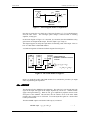
= V1 sin2πf1t + V2 sin2πf2t
........ 8
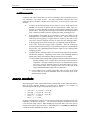
conditions for a null
For a null at the output, sometimes referred to as a ‘balance’, one would be excused for
thinking that:
if:
1) the PHASE SHIFTER is adjusted to introduce a difference of 180o between
its input and output
and
2) the gains ‘g’ and ‘G’ are adjusted to equality
then
3) the amplitude of the output signal y(t) will be zero.
In practice the above procedure will almost certainly not result in zero output ! Here is the
first important observation about the practical modelling of a theoretical concept.
In a practical system there are inevitably small impairments to be accounted for. For
example, the gain through the PHASE SHIFTER is approximately unity, not exactly so. It
would thus be pointless to set the gains ‘g’ and ‘G’ to be precisely equal. Likewise it would
be a waste of time to use an expensive phase meter to set the PHASE SHIFTER to exactly
180o, since there are always small phase shifts not accounted for elsewhere in the model.
These small impairments are unknown, but they are stable.
Once compensated for they produce no further problems.
So we do not make precise adjustments to modules, independently of the system into which
they will be incorporated, and then patch them together and expect the system to behave.
All adjustments are made to the system as a whole to bring about the desired end result.
more insight into the null
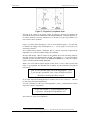
It is instructive to express eqn. (1) in phasor form. Refer to Figure 3.
TIMS Lab Sheet
Copyright © 2005 Emona Instruments Pty Ltd
3/10