1
around file firefinder, and vertical angles arc read from the
scale on the rear sight.
Be careful -- too much tension on the tape will spring the
sight ring and cause it to turn hard.
Care of the Firefinder
You will notice that the azimuth circle, or the rim around
the outside of the Finder Plate, is marked with degrees and
fractions of degrees. “0” (zero) on this rim, when the
firefinder is property oriented, is on the south side of the
rim. This has been done for convenience in reading the
azimuth. If the figures were placed in their true position,
you would have to go around the finder to the opposite side
in order to take the reading, thereby consuming valuable
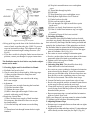
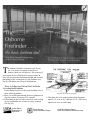
time. Figure 98 pictures the Osborne Firefinder, illustrating
the different parts referred to in the following paragraphs.
1. Keep your firefinder clean. Use solvent if sticky or rusty
and a powdered cleanser for general cleaning. Polish all
brass parts.
2. The firefinder is not intended to be a table. Don’t use it
as a place to set cups, ashtrays, binoculars, clothing, or
books. Use the shelves of your firefinder stand for
storing the items you need to do your job, such as.
binoculars, instruction booklets, pencils, diary and log
book, records and first aid kit. Keep the items on the
shelves arranged neatly.
3. Keep a thin coat of light oil or graphite on tracks and
sight ring to prevent wear and rust.
4. Map should be kept clean and in good condition. If a
new map is needed, notify your Ranger.
Before you close your station protect the Finder as follows:
a. Clean thoroughly.
b. Coat all metal parts with mineral oil.
c. Release tension on cross hairs and distance tape.
d. Remove map and store in dry place or send it to head
quarters as directed.
The Proper Procedure in Using the Firefinder
Is As Follows:
When a fire is “spotted,” turn the sighting ring (D) by use of
handle (J). Your eye should be within two (2) inches of rear
sight (H). Line up the vertical hair of front sight (A) and the
slot in back sight (H) so that vertical hair appears in the
center of the fire. Readings can now be made. (Slide
firefinder on tracks or move to other set of tracks to clear
line of sight around obstructions such as corners of
buildings, stove pipe, or window frame.)
How to Read a Horizontal Angle Or Azimuth
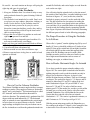
Figure 100 Improper Use
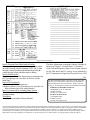
To see how to make the proper azimuth readings, refer
Figure 102. The vernier plate is attached to the movable
sighting ring and is used to read the azimuth, not only in
degrees, but in fractions of degrees. A degree is into
smaller divisions known as minutes. There are 60 minutes
in a degree. The symbol for degree is º. 21 degrees and 30
minutes is abbreviated 21º and 30'. Looking at the Azimuth Graduation in Figure 102 you will find “0” rests
between 21º 30' and 22º. In order to find how many
minutes past 21º30' the marker lies, run the eyes toward the
left until you see a line on the Vernier with a line on the
Azimuth Graduation. You will find that the line on the
Vernier that does coincide with a line on Azimuth
Graduation is “15”. The vernier is graduated in minutes, so
add 15 minutes to 21º 30' and you will get 21º 45'.
Figure 101 Ready for Use
How to Use the Osborne Firefinder
The Osborne Firefinder measures angles similar to compass
readings to smokes. These angles are known as “horizontal
angles” and “vertical angles.” The horizontal angle is called
file “Azimuth” and is measured from the north in a
clockwise direction. The azimuth circle is graduated into 360
degrees with true north indicated by “0”. The horizontal
angle, or azimuth, is more important than the vertical angle
in cases where two or more lookouts see the fire. Vertical
angle readings are helpful where only one lookout can see
the fire. Azimuths are read from the graduated azimuth rim
With the present string maps used by the Dispatcher on a
fire, reading to the nearest 1/2 degree is close enough for him
to start action. You will want to use a finer reading for
3