1
Sampling
Test Evaluation
Use the cotton swab to take a significant amount of faeces. It is sufficient when the
tip of the swab is covered with faeces.
The results of the test can be read within 5-10 minutes of applying the sample fluid.
Practical Tip: Faeces of cats usually are more grainy than dog faeces.
If you cannot pick up sufficient faecal material with the swab, moisten
the tip of the cotton first in the buffer fluid and then pick up the faecal material. Repeat the process until the liquid significantly changes
colour.
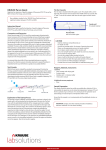
Positive Result
The test is positive when the control line (C) and the test line (T)
appear in the reaction field. Here Giardia was detected.
Even when a weakly defined test line appears, the test result is positive. The red colour in the test region will vary depending on the concentration of pathogens present in the sample.
Negative Result
The test is negative when only the control line appears.
No defined test line is visible. The test on the left displays a clear
negative test result, no Giardia antigen was detected.
After the sampling continue with the test procedure.
1.
2.
IMPORTANT: As cyst excretion does not occur with every passing of
faeces, a negative test result does not necessarily exclude a persistent
Giardia duodenalis infection. The test should be carried out once more
with a pooled faecal sample after approximately one week.
Invalid Result
3.
If no control line appears after the test is performed, the test is invalid. In this case,
it is likely that the test was not correctly carried out or the test may have passed the
expiry. If this occurs, a new test must be conducted.
4.
ATTENTION: The results must be read within 10 minutes of starting the
test. The test and the result are considered invalid after that period.
Storage
Test Procedure
KRUUSE Giardia Quick must be stored at room temperature (2°C to 30°C).
All material used to perform the test should have room temperature
1.
Open the test tube containing the dilution buffer. Take the cotton swab and put the tip of the swab with the faecal sample into the test tube containing the
dilution buffer. Stir up the fluid with the swab. The fluid colour should change into slight yellow/brown.
2. Tightly close the test tube with the buffer. The dilution buffer in the tube will treat and conserve the sample. Shake the test tube well for a few seconds.
Disposal
A safe disposal is recommended. Faecal samples and test cassettes should be
collected in a sealable plastic bag.
Test Performance Characteristics
Sensitivity and Specificity with faeces
KRUUSE Giardia Quick
Enzyme-linked Immunosorbent Assay
3. Take the test tube and break off the pin.
4. Invert the test tube and place 3 drops of the sample fluid into the sample well. Giardia duodenalis
Sensitivity
Specificity
98,15 %
96,13 %
References
Remark: If the liquid is not running well up the strip after 45 seconds,
add an additional drop of buffer material into the sample well
1. Krankheiten der Katze (Hrsg.: M. Chr. Horzinek / Vera Schmidt / Hans Lutz)
Enke, 4. Auflage, 2005, S. 199 – 200
2. Innere Medizin der Kleintiere (von Richard W. Nelson – C. Guillermo Couto) Elsevier, 2006, S. 471
Symbols Used
Only for one use
∑
labsolutions
Content
+30°C
Storage temperature
+4°C
Lot number
www.kruuse.com
Read user instruction carefully
Expiry date