1
Introduction
INTRODUCTION
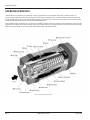
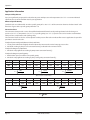
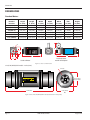
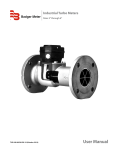
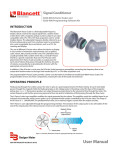
The Inline Pneumatic Flow Meter is a rugged industrial class flow rate indicator and is offered in aluminum, brass, T303 and
T316 stainless steel models to monitor pressurized air lines and a wide range of other compressed gases. Available in seven
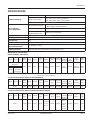
port sizes from 0.25…3 inch for flow ranges from 0.5…5 scfm (0.2…2.2 l/sec) through 200…2200 scfm (75…1130 l/sec),
meters are calibrated at 1.0 specific gravity. In addition to the basic model, the aluminum, brass and T303 stainless steel
models are offered in three configurations: an extended inlet cap fitted with a pressure gauge, an extended inlet cap with a
0.25 inch NPTF plugged gauge port, and a test kit with an extended inlet cap fitted with a 160 psi pressure gauge and control
valve on the outlet.
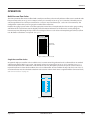
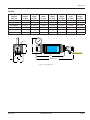
The Flow Meter is equipped with a 360° rotatable guard/scale which allows the meter to be installed in any orientation
without regard to scale direction. Once the meter is permanently installed, the guard/scale can be rotated 360° to
optimize readability.
The unique spring loaded design of this variable area flow meter allows it to be installed in any position, including inverted,
without affecting accuracy. An optional inverted scale is available for these applications.
Aluminum models are offered as a rugged, low cost flow meter for monitoring noncorrosive pneumatic systems under
operating pressures up to 1000 psi (69 bar), 250 psi (17 bar) for 3" models, and 600 psi (41 bar) for test kits.
Brass meters are recommended for applications with operating pressures up to 1000 psi (69 bar) without corrosion inhibitors.
Stainless Steel is available for monitoring systems operating at pressures up to 1500 psi (103 bar). The T316 stainless steel
models are recommended for monitoring caustic or corrosive gases, such as hydrogen chloride or sulfur dioxide. The T303
stainless steel test kit is rated to 600 psi (41 bar); pressure rating is limited by the valve. For further construction material
information, see "Materials of Construction" on page 15 .
August 2014
VAM-UM-00593-EN-02
Page 3