1
repairs...)
action...).
or
deterministic
(timer
triggered
A model of type B does not imply differential equations:
the system can only have a finite or countable number of
states and runs over from a state to another following a
random or deterministic phenomenon.
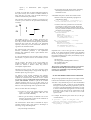
The evolution of the system is therefore a continuous time
stochastic process which can be represented schematically
as follows:
A FIGARO description is made of two kinds of rules:
- interaction rules: they model the propagation of
instantaneous effects.
Ex : IF ( flow(pump1) + flow(pump3) ) <
threshold2 THEN state(alarm) <- 'on';
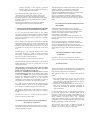
- occurrence rules: they yield the list of events that
may happen in a state of the system. These rules
have a particular semantics, related to time; this is
why they include a distribution law of the time after
which the event will happen:
E1
E0
t
The models of type C (for example : fault trees) are
thoroughly different from the two preceding ones as they
have only a remote relation with the physical phenomena
which rule the system life. The time is not introduced
explicitly. That's why we have called them "abstract" as
opposed to the simulation models.
We wished to find, in the definition of a language which
describes probabilistic problems, a fair equilibrium
between "full" simulation, which is quite detailed, and a
too abstract model.
It is obvious that the first type of model, which is ideal in
the absolute, is in practice too rich to be tractable (in most
cases).
On the contrary, the choice of the C-type model (for
instance a fault tree), or even of a too restrictive B-type
model (for instance a Markov chain) may lead to
unacceptable simplifications.
Therefore we have tried to work out a language which
could describe unambiguously a B-type model, keeping in
mind the objectives given in part I.
An analysis of the existing modelling and computer
languages has shown that none of them provided the
required set of characteristics; therefore we have created
the FIGARO language with specific object-oriented type
syntax and semantics. FIGARO is part of the so-called
"hybrid" languages, that is to say it takes some of its
features from the object-oriented languages and models the
behavior of an object through order 1 production rules.
The use of rules offers two advantages:
- The rules are close to the natural language if their
syntax is selected appropriately: their use will
improve the model readability,
- EDF has got the mastery of different tools in this
field and, in particular, worked on the validation of
0 order production rule bases.
The characteristics which make of FIGARO an objectoriented language bring some decisive advantages in
knowledge storage and among them:
- Easy knowledge classification,
- No repetition (due to the "factorization" allowed by
the heritage mechanism) which is a source of
maintenance errors.
Ex1 : IF state(timer) = 'on'
THEN-MAY-HAPPEN
EVENT down
EFFECT state(timer) <-- 'off'
LAW FIXED_TIME(delay) ;
(* deterministic law *)
Ex2 : IF state(engine) = 'working'
THEN-MAY-HAPPEN
FAILURE breakdown
EFFECT state(engine) <-- 'breakdown'
LAW EXPONENTIAL(lambda) ;
(* constant failure rate *)
Important note: it can be easily proved /4/ (and that will
appear in the below-mentioned examples) that FIGARO
has the very important property to be a generalization of
most of the modelling types used by the reliability experts;
it generalizes in particular:
- the fault trees,
- the state graphs (including Markov chains),
- the stochastic Petri nets,
- the queuing models.
This property of FIGARO ensures that any conventional
model has its FIGARO equivalent and therefore the
exclusive use of FIGARO as representation formalism is
not restrictive whatsoever.
III. FIGARO MODELS PROCESSING METHODS
The processing operations take place in two stages in order
to master the combinatorial explosion problems at best:
*The first is only intended to pass over from the FIGARO
representation of order 1, made up of the knowledge
base types and objects describing a particular system, to
an exactly equivalent FIGARO representation of order
0 which is obtained through application of the heritage
mechanism to the objects and by instanciation of the
first order (generic) rules in the form of zero order
(specific) rules.
For example, the following first order rule (in the type
"circuit-breaker"):
IF position = 'open' OR (FOR_ANY x AN
upstream_component, energised(x) = FALSE)
THEN FOR_ALL y A downstream_component DO
energised(y) <-- FALSE ;