1
University of Florida
Department of Electrical & Computer Engineering
EEL 4744—Summer 1999
Revision 2
SYLLABUS
Page 5/8
Dr. Eric. M. Schwartz
Professors in ECE
14-Jul-99 10:52 AM
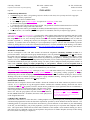
LABORATORY GUIDELINES
LABORATORY OBJECTIVES
The purpose of this laboratory is to teach students hardware and software development of microprocessor based
applications. The laboratory complements the lectures by providing hands-on experience with microprocessors, peripheral
devices and the required hardware and software development tools.
EQUIPMENT REQUIRED
1. MC68HC11EVBU Kit (bring yours)
2. 5-volt regulated power supply (supplied by us)
3. 3-wire, RS232-compatible cable (supplied by us)
LABORATORY PREPARATION
All of the lab experiments require advanced preparation in the form of assembly language coding, simulation, computations
and, of course, reading and understanding the lab handout itself! These preparations must be finished before admittance to
the lab for that experiment and, usually, can be performed on a PC during the week other than at your scheduled lab time.
Listings of pre-lab assembly language code must be in machine printed form and syntactically correct. For your own benefit,
attempt to have logically correct programs before lab as well as syntactically correct code.
LABORATORY ENTRY
The TA's will let you in at the start of your lab period. Your TA has the right to kick you out of the lab if you are not
prepared, i.e., you do not have a completed prelab. Your TA’s will check the following:
• Show your assembly listing to your TA.
• Load your code into a PC and show the TA that your code assembles properly.
• Demonstrate your understanding of the code you brought and the lab topics in general.
If you fail at any of the above, you will get a zero for the lab and will be asked to leave. You may not make-up this lab later.
Therefore, it is imperative that you come to lab prepared!
LABORATORY RULES
1. No food, no drinks, and no smoking inside the Lab!
2. Keep your work area neat and clean it before you leave.
3. Students must attend labs during their assigned time.
4. No extra time will be given for those who cannot finish the experiment in the stipulated time.
5. Labs are precisely 3 hours long (or less, see LABORATORY ENTRY above). You will be given no extra time.
6. You must show up within 1 hour of the lab starting time for check-in. (See above for check-in information.)
LABORATORY ATTENDANCE
Laboratory attendance during scheduled times is mandatory. Documented personal or family emergency will be accepted
as an excuse for absence. In such cases, consult your instructor (not your TA) about a make-up lab during the same week.
Students must make serious attempts on all labs. Grades less than 50% may be interpreted as not a serious attempt and will
be scaled to 0.
If you cannot finish the laboratory during the allotted time, you will lose at least 10% to 30% off your final score. In
general, you are expected to finish the labs on time.
LABORATORY REPORTS
The answer to your lab questions, your circuit diagrams, and your printed listing of your code are turned in at the end of lab.
[If any of the above is essentially identical to another student’s work, this constitutes cheating. If you are caught cheating,
you will be given (as a minimum) a grade of 0 on this lab and reported to the professors for further discipline (which may
result in failing the course, honor court charges, or expulsion).]
You will also turn in your working disk at the end of each lab. This disk will be returned to you at the start of your next lab.