1
Story Driven Modeling and programming with Fujaba
Ira Diethelm
Leif Geiger
Albert Zündorf
Gaußschule
Löwenwall 18a
38100 Braunschweig
FPM, Universität Kassel
Wilhelmshöher Allee 73
34121 Kassel
FPM, Universität Kassel
Wilhelmshöher Allee 73
34121 Kassel
ira.diethelm@unikassel.de
leif.geiger@uni-kassel.de
zuendorf@uni-kassel.de
ABSTRACT
The Unified Modeling Language UML has become the standard language for object-oriented modelling and documentation of software projects. The CASE tool Fujaba now uses
the UML as visual programming language. Fujaba allows to
do every phase of the software development process, from requirements analysis to testing, on the UML level. Fujaba not
only defines a visual programming language but also provides tight tool integration for its own software development
process called Fujaba Process (FUP).
In the FUP the developer systematically derives the complete software specification out of textual descriptions captured
in the requirement phase. This is done in five different phases:
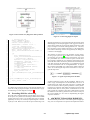
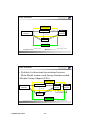
1. For each Usecase the developer writes textual descriptions of several scenarios describing this Usecase.
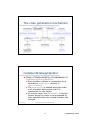
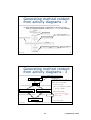
2. The textual descriptions have to be transformed into
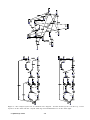
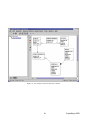
so called Storyboards. These are activity diagrams that
contain object diagrams which describe the flow of the
scenario comic strip like.
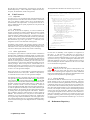
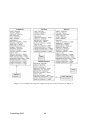
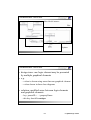
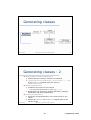
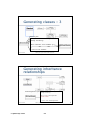
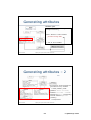
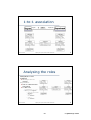
3. The classdiagram is derived (yet) manual but systematically out of the Storyboards.
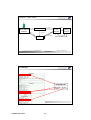
4. For each Storyboard it is possible to generate a test
method automatically which can be used to verify how
many scenarios are already covered by the current implementation. The tests can also be used to ensure
synchrones between scenarios and implementation.
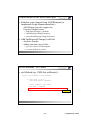
6. Fujaba can now generate standard Java code out which
can then be compiled with a standard Java compiler.
7. The so generated program code can now be tested with
our object browser and visual debugger Dobs.
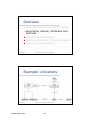
Phase 2 to 5, the systematical derivation from Storyboards
to a complete design specification is called Story Driven Modeling. In our tutorial we show how these systematically
derivations are used and how easy method bodies can be
programmed graphically with Fujaba.
Hope to see you.
1.
REFERENCES
[1] I. Diethelm, L. Geiger, T. Maier, and A. Zündorf.
Turning collaboration diagram strips into storycharts.
In Workshop on Scenarios and state machines: models,
algorithms, and tools; ICSE 2002. Orlando, Florida,
USA, 2002.
[2] I. Diethelm, L. Geiger, and A. Zündorf. Uml im
unterricht: Systematische objektorientierte
problemlösung mit hilfe von szenarien am beispiel der
türme von hanoi. In Erster Workshop der
GI-Fachgruppe Didaktik der Informatik. Bommerholz,
Germany, 2002.
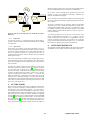
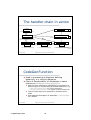
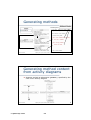
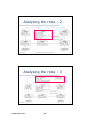
5. By comparison and analysis of all Storyboards with
a special eye on similar and alternative sequences we
manage to create systematically (though manual) the
behavioral description for each method that is involved
in the scenarios. This procedure was first performed
with students of a secondary school in Braunschweig,
see [1, 2].
99
FujabaDays 2003