1
neutron energies, from 800 MeV downwards, is incident on the sample.
Therefore materials like cadmium and gadolinium which might be used in
a reactor situation are useless in the TOF case, and may even be
detrimental because of the high energy y's produced by neutron capture
in those materials. Instead boron, which has a l/v capture cross
section over a wide energy range, is the primary component, with large
amounts of iron and hydrogen (the latter usually in the form of wax or
resin) to provide the basic scattering cross section. Because the final
scattered intensities are small compared to the incident beam
intensity, and because it is essential to provide a radiation free
environment for people working near the diffractometer the TOF
collimator is a massive construction: at ISIS the collimator plus
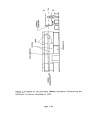
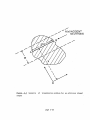
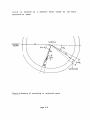
shielding measures typically -1.5m square. Figure 1.3 shows a diagram
of the prototype SANDALS collimator. This collimator is surrounded on
all four sides by about 0.4m of iron, and a further 0.3m borated wax
outside the iron.
The collimator defines a NEUTRON BEAM at the sample position. This
must be sufficiently well collimated to give adequate angular
resolution for the type of experiment being undertaken, but large
enough to give an acceptable count rate. Crystalline powder experiments
generally need high resolution in order to discriminate effectively
between adjacent Bragg reflections and also to determine the sample
constribution to the shape of individual reflections. However because
Bragg reflections are so sharp the count rate is rarely a severe
constraint, unless special effects are being determined, such as the
change in structure as a function of time. For liquids and amorphous
materials however the structure factor consists of a few broad peaks
which merge together, continuously. Detailed analysis of these requires
absolute measurements which can only be achieved through careful and
accurate measurements. In many examples, particularly those which
involve measuring changes in structure as a function of pressure,
temperature or isotope, count rate can be of paramount importance
because of the intrinsic weakness of the signal. Increases in
resolution can only be used if a count rate appropriate to the
resolution is available.
page 1-5