1
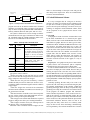
Simple benchmarks are tested using these three
approaches. COMPARE is a 2-input-2-output module
which compares two integers A and B. If A>B, it emits
output O1, otherwise it emits O2. ADDER is a floating
point adder with one input A, one internal parameter B,
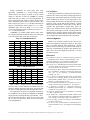
and an output SUM. The results of using software performance estimation and the ISS are shown in Table 2 and
Table 3 respectively, where dctA is the flag of detecting an
input A; A stands for the value of input A; output is the
termination point with 0 for END; estimated is the
clock cycles obtained from the method of [10]; and measured is that from the ISS.
COMPARE is a module without function calls, where
the compiler optimization make the delay of an entire path
to be less than the delay of the sum of each node.
dctA
dctB
0
1
1
1
1
1
2
2
2
3
3
3
0
0
1
1
1
0
1
1
0
1
0
1
1
0
1
1
-
output estimated measured
0
0
0
1
2
0
1
2
0
1
2
57
77
77
77
106
106
67
98
98
41
100
100
51
63
59
49
56
58
49
56
58
66
61
63
Table 3: ADDER MODULE
state
dctA
0
1
1
1
1
1
0
1
1
1
1
A
B
0.1
0
0
0.1
0.1
2.3e12 5.3e8
0.123 0.987
output estimated measured
0
1
1
1
1
1
120
45
887
887
887
887
In this paper, an ISS-based timing refinement scheme is
studied in the context of the Polis codesign approach. By
using the ISS, some intrinsic problems of software performance estimation are solved. An open architecture is presented to adapt the differences among ISS’s. Based on the
properties of the s-graph and the DE semantics, a cached
timing refinement scheme is studied. The result is that for
s-graphs with approximately constant delay paths, the
delay of one execution can be stored and reused the next
time when the same path is traversed. A prototype has been
implemented by using the Ptolemy and the ST20 simulation tools. The result shows that the timing analysis scheme
can be seamlessly integrated into the Polis environment.
Acknowledgments
Table 2: COMPARE MODULE
state
6. Conclusion
114
50
392
755
790
855
Table 3 shows a module with two user defined functions; the delay of these functions are obtained from the
statistic of sample runs with typical inputs. Also notice that
the delay of a same path varies with the input data values.
The experiments are done on a SPARC20 workstation.
For a simulation of 100 firings of COMPARE or ADDER,
despite the time of starting the ISS (approximately 3 Sec.),
the cached timing analysis is about 10 times slower than
that of [10], but 1000 times faster than the non-cached
exact timing analysis.
Thanks to Dr. Luciano Lavagno for his precious comments and suggestions during the working of this paper;
also to Giovanni Bestente, Fabio Bellifemine, Antonio
Bonomo and Giovanni Ghigo of CSELT, Torino, Italy for
their help with defining the problem and outlining solutions. This work is also supported by Edward A. Lee and
the Ptolemy project.
References
[1] F. Balarin, M. Chiodo, etc. “Hardware-Software Co-design of
Embedded Systems”, Kluwer Academic Publishers, 1997
[2] Ptolemy Home Page, “http://ptolemy.eecs.berkeley.edu”
[3] Esterel Home Page, “http://www.inria.tr/meije/esterel”
[4] R. Ernst, W. Ye, “Embedded Program Timing Analysis Based
on Path Clustering and architecture classification”, Proceedings of ICCAD, Nov. 97, PP 598-60
[5] K. ten Hagen, H. Meyr, “Timed and Untimed Hardware Software Cosimulation: Application and Efficient Implementation”, Proc. of Int. Workshop on Hardware-Software
Codesign, Oct. 1993
[6] E. A. Lee and A. Sangiovanni-Vincentelli, “A Denotational
Framework for Comparing Models of Computation”, ERL
Memorandum UCB/ERL M97/11, University of California,
Berkeley, CA 94720, January 30, 1997.
[7] S. Leef, “Hardware and Software Co-Verification - Key to CoDesign”, Electronic Design, September 15, 1997, PP 67-71
[8] C. Passerone, L.Lavagno, etc. “Trade-off Evaluation in
Embedded System Design via Co-simulation”. Proceedings
of ASP-DAC, 1997, PP 291-297.
[9] J. Rowson, “Hardware/Software Co-simulation”, Proceedings
of DAC, 1994, PP 439-440.
[10] K. Suzuki and A. Sangiovanni-Vincentelli, “Efficient Software Performance Estimation Methods for Hardware/Software Codesign”, Proceedings of DAC, 1996, PP605-610.
[11] “ST20 ’Osprey’ Toolset: User Manual”, SGS-THOMSON
Electronics, March 1997
[12] S. Yoo, K. Choi, “Synchronization Overhead Reduction in
Timed Cosimulation”, Proc. of Int. High Level Design Validation.
6th International Workshop on Hardware/Software Co-Design, CODES/CASHE98, Seattle, Washington [USA], 15-18 March 1998
5