1
PC520M_英 06.4.28 3:30 PM ページ 13
D-1034-141 SANWA PC520M(E)
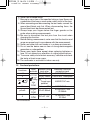
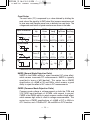
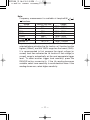
Crest Factor
The crest factor (CF) is expressed by a value obtained by dividing the
peak value of the signal by its RMS value. Most common waveforms such
as sine wave and triangular wave have a relatively low crest factor. The
voltages and crest factors of typical waveforms are shown in the table.
Input Waveform
Sine Wave
Vp
RMS
Vrms
Average
CF
Form Factor
Vavg Vp/Vrms Vrms/Vavg
Vp
2Vp
――
――
2
2
π
=1.414Vrms =0.707Vp =0.637Vp =1.414
Vrms・ 2
π
0
Peak
Vp
2π
π
――
2 2
=1.111
Square Wave
Vp
Vp
0
π
Triangular Wave
Vp
0
π
2π
Vp
Vp
Vp
――
――
3
2
=1.732Vrms =0.577Vp =0.5Vp
Vp
τ
Vp
Vrms・ 3
Puls
0
Vp
1
1
2π
2π
τ
―― •Vp
2π
τ
―― •Vp
2π
=1.732
2
――
3
=1.155
2π
――
τ
2π
――
τ
3
Please note the measurement should be taken at the crest factor below 3.
NMRR (Normal Mode Rejection Ratio)
NMRR is the DMM's ability to reject unwanted AC noise effect,
which causes inaccurate DC measurements. NMRR is typically
specified in terms of dB (decibel). This series has a NMRR
specification of >60dB at 50 and 60Hz, which means a good
ability to reject the effect of AC noise in DC measurements.
CMRR (Common Mode Rejection Ratio)
Common mode voltage is voltage present on both the COM and
VOLTAGE input terminals of a DMM, with respect to ground.
CMRR is the DMM's ability to reject common mode voltage effect,
which causes digit rattle or offset in voltage measurements. This
series has a CMRR specifications of >60dB at DC to 60Hz in
ACV function; and >120dB at DC, 50 and 60Hz in DCV function.
— 13 —