1
Abstract
Protocol conversion for mismatched protocols has been addressed in
a number of formal and informal settings. However, existing solutions
address this problem only partially. This paper develops the first on-thefly local approach to protocol conversion based on temporal logic model
checking. The tableau-based approach verifies the existence of a converter,
and if a converter exists, it is automatically synthesized. Our approach
handles control and data mismatches under a single unifying framework.
A NuSMV-based implementation has been developed and we provide results
for some non-trivial protocol mismatch examples.
1
Introduction
A system-on-a-chip (SoC) is built by reusing components connected using a
central bus such as AMBA [3]. A major problem with this reuse is the inherent mismatch between protocols of components, an active area of research for
about two decades [7]. Mismatches occur because components are developed
independently without any intention of eventual integration, and can result
from control signal mismatches [6], inconsistent naming conventions [11], different clock speeds and difference in data-widths [3]. Mismatches are corrected,
if possible, by synthesizing extra glue-logic, called a converter [10] to control
communication between given protocols in order to satisfy given specifications.
A number of techniques address the problem of protocol conversion in a wide
range of formal and informal settings with varying degrees of automation—
projection approach [7], conversion seeds [9] and synchronization [11]. Some
approaches, like conversion seeds [9] and protocol projections [7], require significant user expertise and guidance. While this problem has been studied in a
number of formal settings [6, 7, 9, 11], only recently have some formal verification based solutions been proposed [3, 5, 10].
In [5], a hybrid simulation/verification approach to protocol conversion in
SoC designs is proposed. [10] proposes an approach towards protocol conversion
employing a game-theoretic framework to generate a converter. This solution is
restricted only to protocols with half-duplex communication between them, with
specifications represented as finite state machines. D’Silva et al [3] present synchronous protocol automata to allow formal protocol specification and matching,
as well as converter synthesis. The technique addresses the problem of limited
communication medium capacity, but data-communication between protocols
cannot be constrained any further.
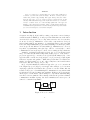
P1
Converter
P2
Specifications
Figure 1: Protocol conversion
1