1
whereas a large amount of stimuli patterns indicates that certain
constants can not be allocated within the circuit. Compaction of
self-test programs only results in 10% - 20% less code because
test programs usually are not highly parallel.
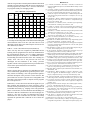
Table 2: RESTART Compilation Results
circuit
# TCL
uncompacted
#
stimuli
#µI
sec #µI/sec
compacted
#µI
sec #µI/sec
simplecpu
7
5
11
0.71
15.5
11
0.71
15.5
demo
16
75
105
26.7
3.93
93
26.2
3.55
demo
17
73
102
26.1
3.9
91
26.46
3.4
mano
12
1
74
14.81
5
58
14.26
4
mano
15
1
136 37.41
3.63
113
36.5
3.1
prips
7
0
17
0.84
17
20.5
0.83
20.2
One of the 16 TCL instructions of program 1 of the demo CPU
is a test loop for detecting faults in the instruction decoding and
control function of the 16 bit ALU (the ALU has two 16-bit
data inputs a and b and a 3-bit control input ctr selects one of 8
ALU functions) as follows:
FOR ctr := 0 TO 7 DO TEST ALU(#5555,#FFFF,ctr);
Above test loop has been compiled by RESTART and the
resulting self-test program has been stored as initialization for
the microinstruction memory. Now we slightly modified the
hardware description of the ALU, i.e. we modified the instruction decoding and control function of the ALU resulting in a
“faulty” ALU. The rest of the processor has been left
unchanged. An RT simulation of the “faulty” processor
together with the self-test program has been performed and of
course all the injected faults have been detected.
7. CONCLUSIONS
We have shown that test programs for embedded processors
can be automatically generated. The generation process essentially consists of matching a test code specification against a
structural description of the processor. For the first time, this
process has been viewed as a special case of retargetable code
generation. It has been possible to compile self-test programs
for several processors.
Furthermore, we have shown how the built-in support for symbolic variables and constraints over these can lead to a more
efficient software production process. Several subproblems can
be handled concurrently e.g. coupling of the code generation
phases: code selection, resource allocation and scheduling. It is
well known that the consideration of all relevant design constraints is a key issue in CAD. CLP languages have built-in
mechanisms for such constraints and we have successfully
exploited the potential that is inherent in one of these languages.
REFERENCES
[1] C. Albrecht, S. Bashford, P. Marwedel, A. Neumann, W. Schenk. The
design of the PRIPS Microprocessor, 4th EUROCHIP-Workshop on VLSI
Training, 1993.
[2] A. Alomary, T. Nakata, Y. Honma, M. Imai, N. Hikichi. An ASIP instruction set optimization algorithm with functional module sharing constraint.
Int. Conf. on Computer-Aided Design (ICCAD), pp. 526-532, 1993.
[3] T. Baba, H. Hagiwara. The MPG System: A Machine-Independent efficient microprogram generator. IEEE Trans. on Computers, Vol. C-30, pp.
373-395, 1981.
[4] R. Beckmann, U. Bieker, I. Markhof. Application of Constraint Logic Programming for VLSI CAD Tools. Constraints in Computational Logic,
First Int. Conf., Munich, 1994.
[5] F. Benhamou, A. Colmerauer (editors). Constraint Logic Programming:
Selected Research. Cambridge, MA: MIT Press, 1993
[6] U. Bieker, A. Neumann. Using logic programming and coroutining for
electronic CAD. 2nd Int. Conf. on the Practical Applications of Prolog,
London, April 1994.
[7] D. Brahme, J. A. Abraham. Functional Testing of Microprocessors. IEEE
Transactions on Computers, Vol. C-33, No. 6, 1984.
[8] W. F. Clocksin. Logic Programming and Digital Circuit Analysis. The
Journal of Logic Programming, pp. 59 - 82, March 1987.
[9] CHIP User’s Guide, COSYTEC SA, Parc Club Orsay Universite, 4, rue
Jean Rostand, 91893 Orsay Cedex, France, 1991.
[10] ECLIPSE 3.4 User Manual. ECRC Common Logic Programming System.
ECRC GmbH, Arabellastr. 17, Munich, Germany, 1994.
[11] A. Fauth, A. Knoll. Automated generation of DSP program development
tools using a machine description formalism. Int. Conf. on Audio, Speech
and Signal Processing, 1993.
[12] M. Ganapathi, C.N. Fisher, J.L. Henessy. Retargetable compiler code generation, ACM Computing Surveys, Vol. 14, (4) 1982.
[13] P. W. Horstmann. Automation of the Design for Testability Using Logic
Programming. Dissertation, University of Missouri, 1983.
[14] Design Automation Standards Subcommittee of the IEEE. Draft standard
VHDL language reference manual. IEEE Standards Department, 1992.
[15] G. Krüger. Automatic generation of Self-Test programs - A new feature of
the MIMOLA design system. 23rd Design Automation Conference, 1986.
[16] G. Krüger. A tool for hierarchical test generation. IEEE Trans. on Computer Aided Design of Integrated Circuits and Systems, Vol. 10, April 1991.
[17] J. Lee, J. Patel. An instruction sequence assembling methodology for testing microprocessors. International Test Conference, 1992.
[18] C. Liem, P. Paulin. Flexware - A flexible firmware development environment. Proc. European Design & Test Conference, pp. 31-37, 1994.
[19] M. Morris Mano. Computer System Architecture. Prentice-Hall Int., Inc.,
Third Edition, 1993.
[20] S. Bashford, U. Bieker, B. Harking, R. Leupers, P. Marwedel, A. Neumann, D. Voggenauer. The MIMOLA Language - Version 4.1. Technical
Report, Computer Science Dpt., University of Dortmund, Sept. 1994.
[21] L. Nowak, P. Marwedel. Verification of hardware descriptions by retargetable code generation. 26th Design Automation Conf., pp. 441-447, 1989.
[22] J. V. Praet, G. Goossens, D. Lanneer, H. D. Man. Instruction set definition
and instruction selection for ASIPs. 7.th Int. Symposium on High-Level
Synthesis, 1994.
[23] Prolog III Reference Manual. PrologIA, Parc Technologique de Luminy Case 919, 13288 Marseille Cedex 09, France, 1991.
[24] H. Simonis. Test generation using the constraint logic programming language CHIP. Proc. of the 6th International Conf. on Logic Programming,
Lisboa, Portugal, pp. 101 - 112, June 1989.
[25] D. Svanaes, E. J. Aas. Test generation through logic programming. NorthHolland, INTEGRATION, the VLSI journal, No. 2, 1984.
[26] S. M. Thatte, J. A. Abraham. Test generation for Microprocessors. IEEE
Transactions on Computers, Vol. C-29, No. 6, 1980.
[27] TMS320C2x User’s Guide, Rev. B, Texas Instruments, 1990.
[28] T. Wilson, G. Grewal, B. Halley, D. Banerji. An integrated approach to
retargetable code generation. 7. th Int. High-Level Synthesis Symp., 1994.