1
Flash Memory Guide
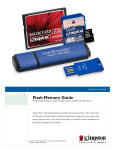
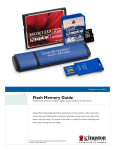
Kingston®, the world’s leading independent manufacturer of memory products, offers a broad range of Flash cards,
USB Flash drives and Solid-State Drives (SSD) (collectively called Flash storage devices) that employ Flash memory
chips for storage. The purpose of this guide is to explain the various technologies and Flash memory offerings that
are available.
Note: Due to Flash technology changes, specifications listed in this document are subject to change without notice
1.0 Flash Memory: Empowering A New Generation of Flash Storage Devices
Toshiba invented Flash memory in the 1980s as a new memory technology that allowed stored data to be saved
even when the memory device was disconnected from its power source. Since then, Flash memory technology has
evolved into the preferred storage media for a variety of consumer and industrial devices.
In consumer devices, Flash memory is widely used in:
•
•
•
•
•
Notebook computers
Tablets
Global Positioning Systems (GPS)
Solid-state music players such as MP3 players
Portable and Home Video game consoles
•
•
•
•
•
Personal computers
Digital cameras
Mobile phones
Electronic musical instruments
Television set-top boxes
Flash memory is also used in many industrial applications where reliability and data retention in power-off situations
are key requirements, such as in:
•
•
•
•
Security systems/IP Cameras
Embedded computers
Networking and communication products
Retail management products (e.g., handheld scanners)
•
•
•
•
Military systems
Set-top boxes
Wireless communication devices
Point of Sale Devices
Please Note: Most Kingston Flash memory is designed and tested for compatibility with consumer devices.
For industrial applications or special use applications that are beyond the standard daily consumer usage,
it is recommended that you contact Kingston directly. A special configuration may be required especially
in applications that will greatly impact Flash cell endurance (see section 3.0).
2.0 SSD, Flash Card and USB Flash Drive Capacity
Some of a Flash storage device’s listed capacity is used for formatting and other functions and thus is not available
for data storage.
When a Flash storage device is designed and manufactured, steps are taken to ensure that the device operates
reliably and to permit the host device (computer, digital camera, tablets, mobile phone, etc.) to access the memory
cells — i.e., to store and retrieve data on the Flash storage device. Formatting includes the following operations:
1