1
Class 1 Bluetooth v2.0 Module
Hardware Integration Guide
3 IO CHARACTERISTICS
3.1 Power Consumption
The current drain from the VCC power input line is dependent on various factors. The three most significant
factors are the voltage level at VCC, UART baud rate, and the operating mode. The hardware specification
for the module allows for a voltage range of 3.3 to 5.0 at VCC. The unit includes a linear regulator and tests
have shown that there is no significant difference in current draw when VCC changes within the operating
limits. Tests have shown that where power dissipation is an issue, it is best to keep VCC at the lower end of
the range.
The UART baud rate has a bearing on power dissipation because, as is normal for digital electronics, the
power requirements increase linearly with increasing clocking frequencies. Because of this, higher baud rates
result in a higher current drain. Finally, the significant operating modes are: idle, waiting for a connection,
inquiring, initiating a connection, sniff, and connected. With connected mode, it is also relevant to
differentiate between no data being transferred and when data is being transferred at the maximum rate
possible. The AT command set document describes how to configure the module for optimal power
performance.
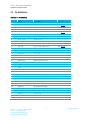
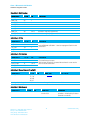
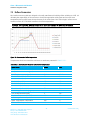
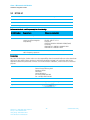
3.2 Typical Current Consumption in mA
Table 4-2: Current Consumption
VCC_IN = 3.8 V, Baudrate = 9600 bps
Typical Average Current (mA)
Separation Distance = 15 meters
Idle Mode, S512=1
1.25 mA
Wait for Connection Or Discoverable Mode,
55 mA
AT+BTP
S508=S510=640, S509=S511=320
Wait for Connection Or Discoverable Mode,
2.7 mA
AT+BTP
S508=S510=1000, S509=S511=11
Inquiry Mode, AT+BTI
65 mA
Connecting Mode (ATDxxx)
66 mA
Connected Mode (No Data Transfer)
6 mA
Connected Mode (Max Data Transfer)
35 mA
Sniff Mode
1.8 mA
S564=1000, S563=500, S562=50, S561=10
Americas: +1-800-492-2320 Option 2
Europe: +44-1628-858-940
Hong Kong: +852-2923-0610
www.lairdtech.com/bluetooth
12
CONN-HIG-BT730_1