1
34
CHAPTER 4. APPLICATIONS OF SUM OF SQUARES PROGRAMMING
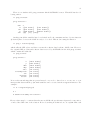
with an equilibrium at the origin. Notice that the linearization of (4.2) has zero eigenvalue, and
therefore cannot be used to analyze local stability of the equilibrium. Now assume that we are
interested in a quadratic Lyapunov function V (x) for proving stability of the system. Then V (x)
must satisfy
V − ǫ(x21 + x22 + x23 ) ≥ 0,
∂V
∂V
∂V
ẋ1 −
ẋ2 −
ẋ3 ≥ 0.
−
∂x1
∂x2
∂x3
(4.3)
The first inequality, with ǫ being any constant greater than zero, is needed to guarantee positive
definiteness of V (x). However, notice that ẋ3 is a rational function, and therefore (4.3) is not a
valid SOSP constraint. But since x23 + 1 > 0 for any x3 , we can just reformulate (4.3) as
−
∂V 2
∂V 2
∂V 2
(x3 + 1)ẋ1 −
(x3 + 1)ẋ2 −
(x + 1)ẋ3 ≥ 0.
∂x1
∂x2
∂x3 3
Thus, we have the following SOSP (we choose ǫ = 1):
SOSDEMO2:
Find a polynomial V (x), such that
V − (x21 + x22 + x23 ) ≥ 0,
∂V 2
∂V 2
∂V 2
−
(x3 + 1)ẋ1 −
(x3 + 1)ẋ2 −
(x + 1)ẋ3 ≥ 0.
∂x1
∂x2
∂x3 3
(4.4)
(4.5)
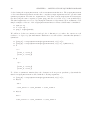
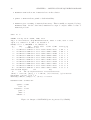
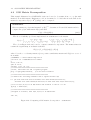
The MATLAB code is available in sosdemo2.m (or sosdemo2p.m, when polynomial objects are
used), and is also shown in Figure 4.2. The result given by SOSTOOLS is
V (x) = 5.5489x21 + 4.1068x22 + 1.7945x23 .
The function findlyap is provided by SOSTOOLS and can be used to compute a polynomial
Lyapunov function for a dynamical system with polynomial vector field. This function take three
arguments, where the first argument is the vector field of the system, the second argument is
the ordering of the independent variables, and the third argument is the degree of the Lyapunov
function. Thus, for example, to compute a quadratic Lyapunov function V (x) for the system
ẋ1 = −x31 + x2 ,
ẋ2 = −x1 − x2 ,
type
>> syms x1 x2;
>> V = findlyap([-x1^3+x2; -x1-x2],[x1; x2],2)
If no such Lyapunov function exists, the function will return an empty V.
4.3
Global and Constrained Optimization
Consider the problem of finding a lower bound for the global minimum of a function f (x), x ∈ Rn .
This problem is addressed in [22], where an SOS-based approach was first used. A relaxation