1
Introduction
Abstracts: DnaSP v. 1.0 DnaSP v. 2.0 DnaSP v. 3.0 DnaSP v. 4.0 DnaSP v. 5.0
Population genetics is a branch of the evolutionary biology that tries to determine the level and distribution of
genetic polymorphism in natural populations and also to detect the evolutionary forces (mutation, migration,
selection and drift) that could determine the pattern of genetic variation observed in natural populations. Ideally,
the best way to quantify genetic variation in natural populations should be by comparison of DNA sequences
(Kreitman 1983). However, although the methodology for DNA sequencing is available since 1977 (Maxam and
Gilbert 1977 Sanger et al. 1977), until 1990 the use of DNA sequence data had had little impact on population
genetics. This is because the effort (in terms of both money and time) required to obtain DNA sequence data from
a relative large number of alleles was substantial.
The introduction of the polymerase chain reaction (PCR) (Saiki et al. 1985; 1988) which allows direct sequencing
of PCR products and avoids, therefore, their cloning, has changed the situation. Undoubtedly this has produced a
revolutionary change in population genetics. Although, at present, population studies at the DNA sequence level
are still scarce and primarily carried out in Drosophila (for example: McDonald and Kreitman 1991 Schaeffer and
Miller 1993 Rozas and Aguadé 1994), they will certainly increase in the future.
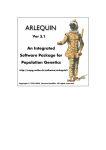
The DnaSP (DNA Sequence Polymorphism) is a software addressed to molecular population geneticists and can
compute several measures of DNA sequence variation within and between populations in noncoding, in
synonymous or in nonsynonymous sites; gene flow, gene conversion (Betrán et al. 1997), recombination and
linkage disequilibrium parameters. In addition, DnaSP performs some neutrality tests: the Hudson, Kreitman and
Aguadé (1987), the Tajima (1989), McDonald and Kreitman 1991; and the Fu and Li (1993) tests. DnaSP takes
advantage of the Microsoft Windows capabilities, so that it can handle a large number of sequences of thousands
of nucleotides each on a microcomputer. Furthermore, DnaSP can easily exchange data with other programs, for
example, programs to perform multiple sequence alignments, phylogenetic tree analysis, or statistical analysis.