1
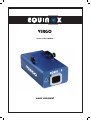
Equinox Virgo Laser
Safety
Licensing and Laws
There are no U.K. “laser laws” or any “laser licenses” that need to be obtained in
order to own or operate a laser for lightshow use. Detailed and specific guidance is issued by the
Health and Safety Executive in the form of a book called HS(G)95 The Radiation Safety of Lasers
Used for Display Purposes.
Class 3B Laser Safety Features
Class 3B laser products need to be fitted with specific safety features. These features are issued
in the British Standard on Laser Product Safety BS/EN 60825-1 and are a needed for the product
to meet CE approval.
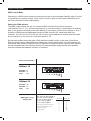
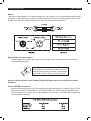
The important warnings are listed below:1) Emissions Indicator
2) Remote Interlock Connector
3) Laser Safety Warning Labels
Summary of each Feature
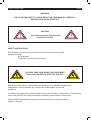
Class 3B lasers need to contain three very importantLaser Safety Warning Labels; the starburst
symbol, aperture label, and the warning/classification label. The starburst is used to indicate that
the product is a laser product. The aperture label is located next to the appature to show where the
laser emits it’s beam(s). The warning/classification label details the class of the laser product, the
maximum output power, and the wavelength(s) (colours) of the laser, along with a
“Laser Radiation – Avoid Exposure To The Beam” warning
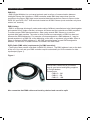
The Remote Interlock Connector will only allow the laser to function when the two pins are shorted
together. For lightshow use it is recommended by HS(G)95 laser safety guidance laser effects can
be overridden by a remote Emergency Stop switch. The remote interlock connector provides a
convenient way for such a switch to be easily added to the laser system, to provide this control.
The emissions indicator is fitted to indicate when the laser is ready to produce a light output.
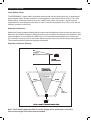
Audience Scanning
Audience Scanning is when laser beams are directed at the viewing audience. Because the laser
output beam can scan people’s faces it carries a risk that it could cause damage to eyesight, if
over exposed to the laser beam.
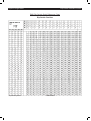
Maximum Permissible Exposure (MPE)
The amount of laser light that a person can be exposed to without it causing harm
to eyesight is known as the Maximum Permissible Exposure or MPE. These levels
are set down by the British Laser Safety Standard BS/EN 60826-1. When people
are exposed to laser light output which is above the MPE, it may potentially pose a risk of causing eye damage. Calculating what the MPE and exposure level is for a given laser effect is quite a
complicated process and it is dependant on a whole number of factors and conditions. The laser
safety standard BS/EN 60825-1 contains the information and data required to calculate these
levels.