1
ones based on the van der Waals model. Still, the additional data needed to use a more advanced model often
gains little in accuracy, and we end up using simpler
models than expected. Considering the pain of accounting
for supercritical components together with subcritical
ones, it would be convenient to find a way of working
with Eq. 5 directly instead of with standard states and activity coefficients.
Also, we have to determine thermal properties (enthalpy, entropy, and heat capacity) that we routinely need
to perform complete material and energy balances. Start by
looking at the exact definition of the fugacity coefficient
from classical thermodynamics and see if there is another
way of solving the problem:
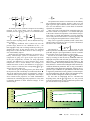
Equation 28 is rigorous thermodynamically, and as long
as we have a functional relationship between pressure,
temperature, volume, and composition, we can calculate
fugacity coefficients, and the phase equilibrium problem is
(formally) resolved. Before we dig deeper into the these relationships (usually called EOS), it is a good idea to look at
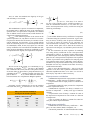
some basic thermodynamic relationships that define enthalpy, entropy, and heat capacity:
V
T ∂P
∂T
0
H=H +
∂P
∂n i
V
T, n j ≠ i
– RT dV – RT ln Z
V
(29)
dV
T, ni
∞
V
RT ln φ =
V,ni
+V ∂P
∂V
S = S0 +
(28)
∞
∂P
∂T
V,ni
– R dV + R ln Z
V
(30)
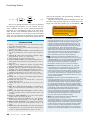
Table 5. Typical steps for a simple flash calculation.
Action
Choose thermodynamic
model, NRTL/Virial
Reason
Tell the simulator the basic
thermodynamic framework
to use to perform
equilibrium calculations.
Hidden Actions
• Select enthalpy, entropy, and heat capacity models.
• Partial molar volume for the liquid-phase model is defined.
Usually pure-component molar volume is used.
• An extrapolation method for the pure-component molar
volume beyond Tc is defined.
P
sat ,solv
• Mixing rule for H i , solvent
is defined. Usually
ajk is set to zero.
• Models for liquid and vapor densities are chosen.
• Model for transport properties are chosen.
• Extrapolation methods for all physical properties are defaulted.
Choose components
from component list
Define mixtures that will be
potentially present in the
simulation.
• Retrieve physical properties from a pure-component database.
• Retrieved properties may have been already estimated. Many times
estimation criteria are not available.
• Missing properties are estimated. Applicability dependent on types
of chemicals in the mixture.
P
• Missing H i , jsat ,solv are estimated.
• Retrieve binary interaction parameters and Henry’s constants from a
database. Parameters may or may not be applicable to conditions of interest.
• Interaction parameters for subcritical binary pairs are estimated
(ranging from a simple setting to zero to group contribution methods).
Define pressure, temperature, Find thermodynamic
and bulk composition
state of mixture.
• Vapor pressures are calculated. Extrapolations are made if
temperature is beyond temperature limits.
• Henry’s constants are calculated. Extrapolations are done if
temperature is beyond temperature limits.
• Activity coefficients are calculated. Extrapolations are done usually
without any check based on actual data used for determination of
interaction parameters.
• Enthalpies, entropies, heat capacities are calculated. Depending on
the temperature, subcritical components may be crossing their critical
temperatures and extrapolations for enthalpy of vaporization are done.
• Transport properties are calculated. Usually, very little, if any,
experimental mixture information is available to help estimation.
CEP
May 2001
www.aiche.org/cep/
51