1
Downloaded from http://www.everyspec.com
MIL-STD-187-31O
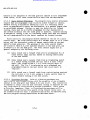
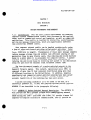
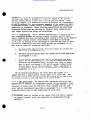
that it can receive no segments other than those from the subscriber
whose call it just accepted. This segment or message receipt is
ms.tricted to only one subscriber at a time. The call will remain up
until either calling or called subscriber initiates a call termination.
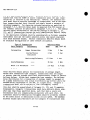
10.1.4 .3.2 Message Type. For message-oriented calls, a leader must
accompany every segment. Although a subscriber may be operating in a
connection made for sending, it can also be receiving in a message
mode, as with a time-sharing terminal user who is able to accept
messages from other users although his dialogue may be with a single
computer.
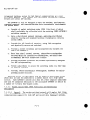
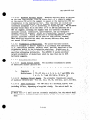
10.1 .4.4 ~amic
Reallocation of Bandwidth. It shall be possible to
dynamically reallocate bandwidth based on terminal needs to integrate, on
a flexible transmission basis, a large variety of terminal data rate
requirements. The 00S shall have the capability to handle increased
transmission speeds such as provided by satellite. If a hierarchy of
switches, concentrators, etc. is required, use of basic building
modules is highly desirable.
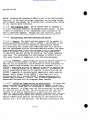
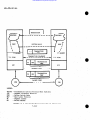
10.1.5 Switch Internal Architecture Features. The switch internal
architecture is concerned with the hardware, software, and firmware
structural configurations used for switching.
10.1.5.1 Modularity. The UDS shall be only as large as’the traffic
density dictates, but it shall be capable of being upgraded by adding
new modules. Internal mode redundancy and distributed cnntrol techniques
shall be used within the nodal architecture to assure graceful degradation of processing functions and capabilities in the event of failure.
Insofar as possible, the network switches will use common, multifunction
equipment for data path connections and signaling, supervision, and control, as well as for switch control, to minimize critical uniquefunction equipments.
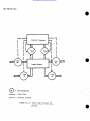
10.1 .5.2 Multiprocessor Functional Arrangement. Characteristics
uossessed by multiprocessors
(which is meant to include multiprocessors,
associative processor, and microprocessors) make them useful as the
basic architecture of an integrated switch. Such characteristics are:
a.
Modular expansion capability
b.
Variable capacity (Same basic architecture can serve different
capacity switches. )
c.
Graceful degradation, due to inherent redundancy
d.
Distributed control
e.
Concurrent processing.
10-1-6