1
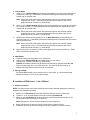
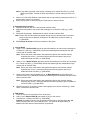
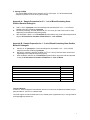
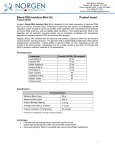
Storage Conditions and Product Stability All solutions should be kept tightly sealed and stored at room temperature. These reagents should remain stable for at least 1 year in their unopened containers. The kit contains a ready-touse Proteinase K solution, which is dissolved in a specially prepared storage buffer. The Proteinase K is stable for up to 1 year after delivery when stored at room temperature. To prolong the lifetime of Proteinase K, storage at 2–8°C is recommended. Precautions and Disclaimers This kit is designed for research purposes only. It is not intended for human or diagnostic use. Ensure that a suitable lab coat, disposable gloves and protective goggles are worn when working with chemicals. For more information, please consult the appropriate Material Safety Data Sheets (MSDSs). These are available as convenient PDF files online at www.norgenbiotek.com. The Lysis Buffer B and Solution WN contain guanidinium salts, and should be handled with care. Guanidinium salts form highly reactive compounds when combined with bleach, thus care must be taken to properly dispose of any of these solutions. Blood of all human and animal subjects is considered potentially infectious. All necessary precautions recommended by the appropriate authorities in the country of use should be taken when working with blood. Customer-Supplied Reagents and Equipment Variable speed swing bucket centrifuge that can reach 4500 x g (5000 rpm) and can accommodate 15 mL centrifuge tubes Micropipettors 96 - 100% ethanol 56°C waterbath or incubator 70ºC incubator Lysozyme (for blood containing Gram positive bacterial pathogens) º 37 C incubator (for blood containing Gram positive bacterial pathogens) Vortex Procedure All centrifugation steps are carried out in a swing bucket centrifuge that can reach 4500 x g (5000 rpm) and can accommodate 15 mL centrifuge tubes. Various speeds are required for different steps, so please check your centrifuge specifications to ensure that it is capable of the proper speeds. All centrifugation steps are performed at room temperature. The correct rpm can be calculated using the formula: RCF RPM = (1.118 x 10⁻⁵) (r) where RCF = required gravitational acceleration (relative centrifugal force in units of g); r = radius of the rotor in cm; and RPM = the number of revolutions per minute required to achieve the necessary g-force. 2