1
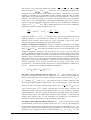
with emission of an unresolved satellite line bundles i , nl → σ , nl and i , n → σ , n of
mean wavelengths
λi ,nl →σ ,nl and λi ,n→σ ,n respectively. The recombination coefficients are
the photon emissivity coefficients for the satellite line bundles. These data are in principle
available in sub-blocks of the intermediate coupling extended ADAS data files of format
adf09 and are to be mapped from there as ‘L-lines’ in the final adf04 file. There are two
problems. The bundle wavelength is not explicit in the adf09 format and the intermediate
parent states, i , are not distinguished. The dominant intermediate parent state is however
implicit in the low temperature exponential behaviour of the recombination coefficients.
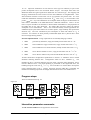
α ~ Te−3 / 2 e − ∆E / kTe then ∆E is obtained from the first two non-zero coefficients
(tabulated as a function of electron temperature Te ) as
Assume
I
I
∆E
= − ln( α 1Te31 / 2 / α 2 Te321/ 2 ) /( H − H )
IH
kTe1 kTe21
8.5.6
Comparison of ∆E + ( z + 1 ) I H / n with the explicit parent energy differences from the
adf09 file identifies i and the hence the satellite line parent transition i → σ . It is
sufficient for the precision here to take the ‘L-line’ wavelength as that of the parent
transition although hand-adjustment may subsequently be made.
2
2
Radiative recombination contributions There is no radiative recombination to the doubly
excited states. Radiative recombination is however required to the bundled singly excited
+z
+z
states X σ ,nl and X σ ,n . These data are included as ‘R-lines’ in the final adf04 file. In the
subsequent population calculations, they are added to the ‘L-lines’ to give the total free
electron spontaneous recombination (direct and resonant) to bundled singly excited levels.
The ADAS data format adf08 can contain the required data for direct mapping to the final
adf04 file. There is a bundling issue. It has been our usual practice to prepare adf08 files for
fully resolved levels in a term-coupling representation and this format has recently been
extended to a level-coupling representation. These are the natural resolutions for the most
detailed examination of the spectral emission from the singly excited states of the
recombined ion. We continue to follow this practice so that the tabulations in adf08 are of
α σ( r→)σ ,nlΓ . These data are extracted and subsequently bundled as
α σ( r→)σ ,n = ∑ α σ( r→)σ ,nl = ∑ α σ( r→)σ ,nlΓ
8.5.7
l ,Γ
l
+z
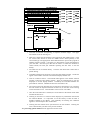
The automatic adf04 file
The singly excited collisional-radiative matrix for X
generation by ADAS703 creates the rate coefficients for a working collisional-radiative
+z
matrix of spontaneous and electron impact collisional processes connecting levels X i ,nlΓ of
X + z including X σ+ ,znlΓ with n < n0 . The collisional rates are however obtained in the
dipole allowed impact parameter approximation. Also, the automatically created adf04 file
+z
+z
contains no data for the higher bundled singly excited states X σ ,nl and X σ ,n . For the
+z
singly excited system X σ ,nlΓ usually collisional data of much higher precision and
completeness which extend to principal quantum shells n ≥ n0 are available in separately
prepared adf04 files. We seek to merge the data from these higher quality sources and so
substitute inferior data in the automatically created file where possible. In extracting and
merging these improved data, nl- and n-bundling are required and are performed as
necessary to match the bundling used in the preparation of the ‘L-lines’.
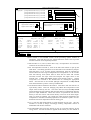
The doubly excited collisional-radiative matrix for X
+z
As for the singly excited system
+z
the redistributive processes for the doubly excited levels X i ,nlΓ with n < n0 including the
+z
are
electron impact collisional rate coefficients from the ground and metastables of X
generated in the dipole allowed impact parameter approximation. Such data are of particular
+z
+z
weakness for the so-called inner shell excitation reactions X g ,m + e → X i ,nlΓ + e with
ADAS User manual
Chap8-05
17 March 2003