1
Aug18-03
ADAS Bulletin
There are rather a lot of structural changes and overhauls of key codes as well as the usual bug
fixes for this release together with a large amount of new data. Incidentally this release is version 2.7
since we include a new main program – ADAS8#1, the first of the offline_adas/ programs anticipated in
the user manual (appendix B). The heavy species development has caused the principal trials and
tribulations and has had a major knock-on effect in that it has prompted us to rationalise a lot of code –
especially adas2xx and adas4xx – and to organise and improve the subroutines giving access to ADAS
data formats. The latter problem is highlighted by the adf04 specific ion file class. This format has
evolved over the years and we have many separate subroutines which access adf04 (bxdata, badata
b8data etc.) but mostly accessing some part of the data and not adf04’s full glory. We are seeking to
get rid of some of these, now unnnecessary, variants. Finally we have upgraded ADAS408 to handle
power filtering properly – that means including arbitrary filter files (adf35), such as those produced by
ADAS414 using Henke data, which we set up the machinery for some time ago.
So I wish to split the bulletin up into five parts as follows:
1. Review and update on the disposition and use of access routines to ADAS data formats
and codes
2. An introduction to ADAS8#1
3. The detailed corrections and additions to codes.
4. New and replaced data - note that data in error we replace, upgraded data is given a new
name
5. The upgraded ADAS408.
Fig. 1
/.../adas/
/.../adas/idl_adas/
/.../adas/idl_adas/idl/
primary ADAS code
space
IDL language code
space
/.../adas/lib/
/.../adas/idl_adas/C/
Fortran scannable object
module libraries by series
C language general
space
1
2
/.../adas/idl_adas/fortran/
FORTRAN language code
space
4
/.../adas/idl_adas/wrapper/
wrappers for idl procedures
calling fortran subroutines
/.../adas/idl_adas/read_adf/
specific wrappers for
idl procedures using
fortran adf reading subroutines
3
5
/.../adas/offline_adas/
system for very large
scale ADAS computations
/.../adas/offline_adas/<codes>/
integrated off-line codes
associated with ADAS
1
1.
Access to ADAS data and codes from IDL and fortran
I draw your attention to a chart (figure 1) from the ADAS user manual appendix B showing the
disposition of ADAS code. Passing down into the IDL code region at (1), we have figure 2. At (2.1),
the directory read_adf/ contains the IDL procedures such as read_adf01.pro which allowing reading of
(selected) data from the appropriate adf number at the IDL command line. Also note at (2.3)
procedures which allow running of a complete ADAS code at the command line taking parameters from
the command line rather than from widgets. We have added to both these categories in this release.
Note at (2.4) a new type of named procedure, such as xxdata_04.pro which read a complete adf file
from the IDL command line. They follow exactly their associated fortran subroutine (see below) in
positional parameter arrangement. Note that read_adf04.pro remains the normally preferred access
from IDL..
Fig. 2
/.../adas/idl_adas/idl/
/.../adas/idl_adas/idl/adas1xx/
/.../adas/idl_adas/idl/adas1xx/adas101/
/.../adas/idl_adas/idl/adas1xx/adas102/
/.../adas/idl_adas/idl/adas1xx/adaslib/
/.../adas/idl_adas/idl/adas2xx/
/.../adas/idl_adas/idl/adas2xx/adas201/
/.../adas/idl_adas/idl/adas2xx/adas202/
2.3
run_adas204.pro
/.../adas/idl_adas/idl/adas2xx/adaslib/
/.../adas/idl_adas/idl/adaslib/
read_adf01.pro
2.2
read_adf02.pro
/.../adas/idl_adas/idl/read_adf/
2.1
xxdata_04.pro
2.4
xxdata_04.pro
We have introduced a parallel fortran/read_adf/ directory in the fortran code region as shown in figure
3 [following on from (2) in figure 1]. The aim is to access ADAS complete adf datasets via
xxdata_<XX>.for routines stored in fortran/read_adf/ which will have their own scannable object
module library libread_adf.a as shown at (4) in figure 1. Only a limited number have been prepared so
far. A number of old style <letter><number>data.for routines have been replaced and although the old
versions will remain they will not be updated. (3.1) in figure 3 shows the xxdata_YY.for routines which
have been put in place in this release. The fortran scannable object module libraries which users can
access from their own codes are summarised in figure 4 –in particular at (4.1) note the new
libread_adf.a one. Note that for IDL procedures calling fortran subroutines, we operate via wrappers
and a C interface. The interfacing codes are of less interest to the general user but their position is
2
noted at (3) in figure 1. This whole arrangement means that it will be easy and tidy to introduce calling
from other languages such as MATLAB – a demonstration version of which is in preparation.
Fig. 3
/.../adas/idl_adas/fortran
/.../adas/idl_adas/fortran/adas1xx/
/.../adas/idl_adas/fortran/adas1xx/adas101/
/.../adas/idl_adas/fortran/adas1xx/adas102/
/.../adas/idl_adas/fortran/adas1xx/adaslib/
/.../adas/idl_adas/fortran/adas2xx/
/.../adas/idl_adas/fortran/adas2xx/adas201/
/.../adas/idl_adas/fortran/adas2xx/adas202/
/.../adas/idl_adas/fortran/adas2xx/adaslib/
/.../adas/idl_adas/fortran/adaslib/
/.../adas/idl_adas/fortran/read_adf/
xxdata_03.for
3.1
xxdata_04.for
xxdata_20.for
xxdata_42.for
Fig. 4.
/.../adas/lib/
Fortran scannable object
module libraries by series
libadaslib.a
libadas1xx.a
libadas2xx.a
libadas3xx.a
libadas4xx.a
4.1
libadas5xx.a
libread_adf.a
3
2.
ADAS8#1 for the offline calculation of heavy species ionisation and emission data
A new principal directory offline_adas/ has been set up as shown at (5) in figure 1 to hold the offline
codes. At this time, we are releasing ADAS8#1. ADAS8#1 is essentially doing the work of ADAS801,
ADAS407, ADAS408 and ADAS810 for all the ions of a heavy element in one go. It is set up to
execute on large (probably) parallel machines under scripts. The scripts need to be adjusted for the
disposition of code and data on the user’s machine. The source code should reside in central ADAS,
but the compilation script should be adjusted to put the executables at the user laboratory’s chosen
location.
Fig. 5.
/.../adas/offline_adas/adas8#1/
/.../adas/offline_adas/adas8#1/adas2xx/
/.../adas/offline_adas/adas8#1/adas801/
/.../adas/offline_adas/adas8#1/adas801/common/
/.../adas/offline_adas/adas8#1/adas801/ifg/
/.../adas/offline_adas/adas8#1/adas801/ifgpp/
/.../adas/offline_adas/adas8#1/adas801/include/
/.../adas/offline_adas/adas8#1/adas801/rcg/
/.../adas/offline_adas/adas8#1/adas801/rcn/
/.../adas/offline_adas/adas8#1/adas801/rcn2/
/.../adas/offline_adas/adas8#1/adas810/
/.../adas/offline_adas/adas8#1/adaslib/
/.../adas/offline_adas/adas8#1/bin/
/.../adas/offline_adas/adas8#1/data/
/.../adas/offline_adas/adas8#1/example/
/.../adas/offline_adas/adas8#1/read_adf/
/.../adas/offline_adas/adas8#1/scripts/
adas8#1_README
setup_adas8#1_from_central
make_adas8#1
Figure 5 shows the sub-directory layout for ADAS8#1. Note the equivalence to the online organisation.
Mostly the online routines are used but copied into the new structure. It will be an ongoing necessary
task to keep the on-line and off-line systems properly aligned.
Concerning the directories as shown in the above figure within adas8#1:
adas2xx/:
Contains the required fortran series 2 subroutines. These come from
adas2xx/adaslib adas208 and adas210 but are all placed in the one
directory.
adas801/common/: The same layout as in fortran/adas8xx/adas801/. Likewise ifg/, ifgpp/,
include/, rcg/, rcn/, rcn2/
4
adas810/:
adaslib/:
bin/:
data/:
example/ :
read_adf/ :
scripts/:
Same as fortran/adas8xx/adas810 but adas810.for replaced with
adas810_offline.for.
Required files from fortran/adaslib.
Location of the binaries adas810_offline.x, ifgpp.x, ifg.x, rcg.x, rcn2.x and
rcn.x
Location for coefficients of fractional parentage. This has more f-shells than
the central version.
Xe39+ sample files.
xxdata_04.for and xxdata_42.for are copied to here.
run_adas8#1 - a perl script which runs Cowan code and (optionally) the
adas810_offline code.
For this first release the adas8#1/adas801 and fortran/adas8xx/adas801 are identical. We hope to keep
them in synch but allowing the respective include files to differ.
Some top level files are also present:
README : Gives the user some idea of how to use it - this should be refined in time.
setup_from_central : Copies central ADAS files to offline_adas/adas8#1. There should be
no need for an end-user to use this script.
make_adas8#1 : Compiles the fortran by calling the makefile in each directory.
We expect that we would not compile or set the paths for adas8#1 code. The user would copy it to his
machine of choice and enable it himself. Any changes necessary should be communicated back to us
for incorporation into the next release. Each release we shall keep the central ADAS files up to date.
There are some omissions which we have not had time to finish. Allan's script to farm out the jobs to
different processors on parallel system is not included.. An offline version of ADAS407 is also
missing. We shall correct this soon and use offline version of ADAS407 and ADAS408 in the script.
However the current online version copes with the larger adf04 files. This means that the ADAS407
and ADAS408 steps are done with interactive IDL-ADAS at this stage.
Then the steps to get the ADAS8#1 system running (to be considered along with the flow chart of figure
6 below) are as follow:
1.
Compile by running the make_adas8#1 script. It may be necessary to change the location of the sh
(bash or ksh family) shell location.
2.
Alter run_adas801 script to customise paths and file locations
line 1 : perl path. Use "which perl" to find out where perl is on your system.
Find "# Site specific location details" and alter the $fdir and $cfp variables to point to your file
locations.
The example/ directory contains an Xe39+ example. Copy the test_adf34.dat, test_inst.dat and
test_pp.dat files to your working directory and then run_adas8#1 from the scripts directory. This
generates the adf04 files only. In general you prepare the drivers for the ADAS801 part
(_adf34.dat normally archived in adf34/ and inst.dat and pp.dat files- normally archived in adf41/)
and the drivers for the ADAS810 part (_pec_drv.dat normally archived in adf42/) for an element
by executing ADAS808 in IDL_ADAS.
3.
The loadleveler_submit command is for those (lucky?) people with the LoadLeveler batch
submission system.
4.
Use ADAS407 and ADAS408 in IDL-ADAS for the moment to produce the adf03 files and then
the main adf11 files
5.
To produce adf15 pec, adf11 plt and adf42 fpec files (as well as adf04 files) copy the
test_adf42.dat example and launch run_adas8#1 with extra arguments as: ..
./offline_adas/adas8#1/scripts/run_adas8#1 test_adf34.dat test_inst.dat test_pp.dat
test_adf42.dat.
5
Note that we can get the usual paper.txt file by adding its name after the test_adf42.dat in the
command line above.
6.
The output files are set in test_adf42.dat.
working directory
ADF03
Drivers
for
ADAS801
ADAS808
drivers
for
ADAS8#1
( _adf34, _inst,
_pp ,_pec_drv
files)
Interactive survey
and
generation
of
driver files
ADF11
Drivers
for
ADAS810
Copy to archive
Drivers
for
ADAS801
Drivers
for
ADAS801
Drivers
for
ADAS810
run_adsa8#1
run_adsa8#1
restricted
parameter form
to generate
adf04 only
full parameter
form
to generate
adf04, adf15,
adf1_plt, adf40
ADF15
Drivers
for
ADAS801
ADF40
Drivers
for
ADAS810
working directory
adf04-format
files
ADAS407
Interactive
generation
of
adf03 parameter
files
working directory
adf03-format
parameter files
adf15,
adf11_plt
and adf40
format files
ADAS408
Interactive
generation
of
adf11
coll-radiative
files
Copy to archive
ADF42
Copy to archive
ADF41
Copy to archive
scripts
ADF34
ADF04
Drivers
for
ADAS801
working directory
adf11-format
files
3.
C.1
Corrections and additions to codes (ADAS v2.6 to ADAS v2.7)
Adding to the set of IDL run time versions of the interactive codes is run_adas204.pro.
C.2
The outer Te/density loop in run_adas405, which allows it to calculate arbitrary size inputs,
redefined the loop variable inside the loop. This causes it to terminate early rather than failing
spectacularly. (Fortran doesn't allow this!).
C.3
The cw_adas8xx_infile is out of step with cw_adas_infile. ADAS809 calls it but the only
difference is that 809 requires a smaller number of lines in the input window - this
functionalilty is provided by the ysize parameter in cw_adas_infile.pro.
Minor (non-fatal) syntax error in adas809.for call to h9spf1.
C.4
ADAS801 fortran has been synchronised with the offline ADAS8#1 version. Parameters may
be different but the code should be the same. A new include directory, updated comp scripts
and new binary names (rcn.x, rcnx.x, rcg.x, ifg.x and ifgpp.x) necessitate some changes in the
make script and in the 801 IDL branch.
6
Note that ifgpp has been changed frequently since the last release.
Subsequent change to rcg/coeff.for to fix NAN problem uncovered by Thomas Kreucken. A
variable was not initialised but this error does not invalidate any previous results.
Replace the infamous 'stop 57' with a 'stop Too many transitions' message in rcg. The logic in
spectr.for is extremely convoluted and appears to use an energy grid overrun to test whether
too many transitions are included.
The idea is that collision calculations require all transitions so they cannot be treated in
batches. Some new variables were added to allow for a future separation between spectrum
lines and maximum number of collisions.
For now set klam equal to ktran and trap the error in the interactive ADAS801. Output ktran at
start of rcg and add a new function to ADAS801 to compare this with the number of spectral
lines produced. If there are too many, pop-up a message and do not continue with the
ADAS801 program.
In the born.for subroutine the interpolation of the generalised oscillator strength fails
occasionally when using Aitken interpolation (aknint.for) and a negative value is returned. In
these cases we try xxspln and if this fails the value is set to zero.
Batch operation of ADAS801 has now been activated.
C.7
New idl/adas8xx/adaslib directory with Allan's adf34 file verification code.
C.8
Add Hugh's xxdata_04.for routine which reads adf04 files of arbitrary complexity. Two
changes made to his original version: Replace the inline function, indx, with a call to
adaslib/i4idfl.for. A new parameter, itieactn which determines how xxdata_04 deals with
untied levels. This is an integer switch and acts according to
0 : default - stops if untied levels are found.
1 : continues and fills ltied array but note that further processing will probably fail.
2 : effective untied levels...........NOT YET IMPLEMENTED
xxdata_04 requires xxpars.for and xxprs1.for in adaslib.
The introduction of this class of routines allows us to take the opportunity to gather all adf
reading routines together. The IDL branch has begun this process so we continue with the
same idea on the FORTRAN side. Introduce the fortran/read_adf/ directory with associated
library, libread_adf.a. Then to read any ADAS dataset from a user's program will require
linking against -ladaslib and -lreadadf.
The ultimate aim must be to rationalise ADAS such that the fortran/read_adf/xxdata_YY.for
routines are the only ones used for reading ADAS data. We can migrate to using the new
system slowly by moving and renaming the various <series><member>data.for routines.
All codes which used bxdata have now been converted to use xxdata_04 (C.9 below).
Therefore a warning had been added to bxdata advising that it is deprecated. It will still run
and there is no need to remove it from the system but it may gradually lose functionality.
C.9
The heavy species work has motivated us to begin replacing many different adf04 reading
routines with xxdata_04.for. This affects quite a number of codes and routines. The
opportunity for some tidying and rationalisation was taken at the same time.
Changed and new library routines.
adas_progressbar.pro - new general standalone widget which increments a progress
bar by listening to output from fortran code. The number of
steps is required input.
7
xxminv.for
bxsetp.for
bxout0.for
bxttyp.for
- dimensions increased (1200 max levels).
- sends level identifer string to IDL. This was restricted to 99
levels irrespective of number in adf04 file. ADAS206 used
this list for both metastables and transition table which
overflowed. Change back to sending all levels and alter IDL
to ask for metastable in an embedded panel (no longer pops
up). Change 205 to keep appearances the same!
- format change to accommodate up to 9999 levels and 99999
transitions.
- As this is usually called immediately after reading an adf04
file it was aligned with all the data returned from xxdata_04.
The original version was replaced with b8ttyp. Affected
codes are 201, 205, 206, 214, 407 and 412.
Codes affected by the above changes are:
All:
ADAS201:
ADAS205:
ADAS206:
ADAS207:
ADAS407:
Increase NDLEV to 1000 and NDTRN to 15000 and alter
output file formats to accomodate these new maxima. This
may cause problems if paper.txt is parsed.
Dimensions only.
As well as accepting the larger adf04 files
- Put up a progress bar during calculation. It scales as
O(n**3) so we can be waiting for a long time.
- Any level can be designated as a metastable. Replace the
pop-up selector box with one that can be set from the
processing screen and scrolled to see all the levels. As
it's energy ordered we rarely need to scroll!
- Hugh's change to put on the output graph only those levels
which are plotted.
Same changes as ADAS205.
Can read new, larger, contour and adf04 files. Because of
the increased number of transitions the selection of lines can
become too large, even with the wavelength limits in place.
IDL may refuse to render the widget or it may generate an
X-server error.
- Transition selection is now a moveable window controlled
by advance/retard 'tape recorder' buttons.
- b7datc.for has been rewritten to do a consistency check
between the adf04 and contour files. Previously it read
in the adf04 data also.
Lots of changes here in both functioning and at the user
interaction level.
- All information is now read in from adf04 files and they are
no longer rewound to read in extra information.
- The analysis routines, d7exps, d7alfs and d7auts have been
tidied up, made implicit none, and redundant varaibles,
calculations and format statements have been removed.
- It is no longer necessary to have a fake fully stripped adf04
file. The program knows when the first one in H-like. At
the IDL level the option is de-sensitised.
- A bug whereby the metastable selection list was one pixel
high when starting without a defaults file has been fixed.
- In the automatic branch a file prefix can be specified adf04 files no longer need to conform to
ls#<element><iz>.dat. Now they must look like
<prefix>#<element><iz>.dat.
- In the automatic branch the type of parameterisation (A or
B) can be chosen. Hitherto it forced type A.
8
- In cases where there is no spin system connection between
adjacent ions we now force it to be ground. The proper
solution is to use IC and not LS input files. A warning
is sent to the screen. Note this only affects the adf03 file
generation and not the mainbn (adf25) ADAS204 input
files. The automatic branch will not produce these files
in any case.
- The defaults file has changed.
ADAS412:
ADAS214:
ADAS810:
Use xxdata_04 to read in adf04 files but do not increase
NDLEV and NDTRAN yet.
Use xxdata_04 to read in adf04 files but do not increase
NDLEV and NDTRAN yet. Essentially the same change as
412 but this has bexcoef.for rather than xcoef.for which are
almost identical except for one additional output parameter.
We should perhaps eventually make one universal routine!
Bring into line with new names and some minor alterations.
- Change badata and b8ttyp to xxdata_04 and bxttyp.
- Move haddat to read_adf/xxdata_42.for to keep
consistency in reading adf files.
- Increase dimensions (levels to 1200)
- Write title of run to paper.txt.
- bxcoef.for, the population calculation routine, had its
dimensions increased to stay consistent with ADAS810.
Unfortunately it's not possible to make it completely
independent as there are internal dimensions which must
be matched to calling sizes.
- Checking of metastables selected is improved at the IDL
level.
C.10
Unfortunately intended changes to ADAS808 have not yet been made. It certainly remains
sub-optimal.
C.11
Allan has extended read_adf15.pro and read_adf13.pro to return the atomic number and ion
charge as optional outputs. The data is read from the first line of the file and although it is not
part of the formal specification it is present in all central ADAS files. If it is not present values
of -1 are returned.
Also increased the number of blocks read_adf15 can accept in an adf15 file. There were some
datasets in central ADAS which could not be read completely.
C.12
Dimension mismatch problem with read_adf21. Incorrect results were returned when more
than one stopping impurity was requested.
Take opportunity to extend the number of energy/density/temperature points by blocking data
in groups. Makes it similar to other read_adfXX routines.
Note that read_adf22 acquires these changes automatically.
C.13
Lingering IDL v5.5 array of 1 problems. This time in ADAS208 in the popup 208 version of
502 to get ionisation rates. This occured when checking the polynominal fit parameters. Why
this option is there at all is perhaps now questionable.
C.14
Add extra error checking to xxtext.pro to check whether a file exists before trying to display it.
Rare error condition if a directory is selected and browse comments is possible.
C.15
As xxdata_04.for is now the preferred method of accessing adf04 data, the read_adf04.pro
routine has been changed to use it. This could have been done by adding a read_adf04/
9
directory with readadf04.for, read_adf04.c etc. as in some of the other routines. But the IDL
read_adf routines are not direct implementation of the fortran access routines; typically they
are more like the series 5 codes. Also the more complete set of data returned from xxdata_04
is useful when other fortran routines acquire IDL wrappers.
Therefore there is now an IDL versions of xxdata_04. The argument list is the same as fortran
except that the file name is passed rather than a unit number (and the adf04 file opened outside
xxdata_04) and logicals are replaced by integers (0 and 1 for false and true) because IDL does
not have a logical type. The parameters are not keywords so position and correct positioning
are important. However it is not necessary to declare arrays before calling it.
Also required was an IDL version of bxttyp. Arguments are the same as the fortran and the
same warnings about number and position apply.
These routines allow for a simple change to read_adf04.pro.
Note there is a new directory, idl_adas/wrapper/read_adf to store the code for interfacing with
the fortran/read_adf routines.
read_adf04.pro now traps for the case where there are no S-lines or no zpla data in the adf04
file and the /ecipcalc option is chosen. Previously this would cause a crash.
C.16
A new read_adf20.pro for reading in adf20, G(T), data. We have taken the opportunity for
making fortran/read_adf/xxdata_20.for.
Although G(T)s are mainly used in astrophysics where kelvin is the preferred temperature unit,
the default assumption here is that Te is in eV to keep consistency between the various
read_adfXX routines. There is always the /kelvin keyword.
C.17
ADAS506 was changed to use xxdata_20 rather than e6data. Just like bxdata, e6data now
puts up a warning advising that it is deprecated. It still remains in central ADAS but will not be
updated
C.18
As the batch system at JET keeps changing remove the handling of this to a new subroutine,
loadleveler.pro. batch.pro still has some JET specific handling but it is now just a few lines.
C.19
ADAS408 has been overhauled and now gets its filter data from adf35 datasets rather than
from a built-in routine which assummed a Be window and Si diode. This routine was actually
quite poor in generating the transmission function. The interpolation routine, d8tran, has been
re-written and it no longer calculates the transmission fraction from formulae with embedded
coefficients. It was necessary to account for the various absorption edges and some extra
library routines were required. The running time may be longer but this penalty will only occur
if an adf35 filter file is chosen.
The ADAS408 screens have been completely changed.
The new adaslib routines are
i4indfvs.for:
xxpint.for:
xxmerg.for:
Finds closest index in a non monotonic array. Note that vs
stands for variable spacing!
Simple polynominal interpolation.
Merges two grids and eliminates any duplicate enteries. Uses
some netlib and BLAS routines which are included in the
subroutine (following xxeign.for).
Note also that xxdata_03.for replaces d8data.for to keep with the new data access naming.
*** Remove all files from fortran/adas4xx/adas408 and idl/adas4xx/adas408 and
replace with new set.
10
C.20
A read_adf35.pro was added also. This is similar to read_adf04.pro in that a xxdata_35.pro is
also provided. This uses a wrapper version of d8tran to interpolate user requested values.
C.21
Files which should not be present! Remove from idl_adas/idl/adas4xx/adas414 the following
plot_diff.pro
phenke.pro
plot_henke.pro
onoff.pro
filter.pro
C.22
There was a problem plotting the total energy excess plot in ADAS406. The
adas406_4_plot.pro routine looks as if it was copied from another and edited without being
tested. Two variables (first & last) were not set so I suspect that this option was never used.
Odd considering that it was at version 1.2!
Add ADAS406 as another interactive code which has an IDL run time version
(run_adas406.pro).
C.23
A new library libreadadf.a has been made in /home/adas/lib
C.24
A late change has been made to ADAS205 and ADAS206. If ionisation from excited levels is
chosen as an option and the adf04 file contains levels above the ionisation potential, then the
resulting populations can appear as NANs. In this situation we switch off ionisation from ALL
levels.
C.25
We have brought ADAS701 and ADAS702 into line with Nigel’s latest versions
(autostructure v1.18 and adasdr v1.10).
The file opening system in ADAS702 requires some changes. The input files expected o1, o2,
o3 and o4 (or their unformatted equivalents o1u, o2u, o3u and o4u) are input as before.
Previously these were opened simultaneously in ADAS702 with g2open. Now they are
opened dynamically in adasdr.for. Therefore we no longer need g2open.
4.
Corrections and updates to data (ADAS v2.6 to ADAS v2.7)
D.1
New adf04 files from Nigel and his collaborators:
adf04/belike/belike_dcg03#c2.dat
Don Griffin
adf04/belike/belike_nrb03#b1.dat
Nigel Badnell
adf04/helike/helike_mab03#ne8.dat Manuel Bautista
D.2
Thomas Puetterich found an error in adf00/re.dat - Re28+ had too many electrons. There is a
replacement
adf00/re.dat
For adf00/h.dat – adf00/ne.dat, the ionisation potentials are replaced with those from Kelly.
D.3
New argon charge exchange and CXS emissivity files are added. The cross section data is
from ORNL. CTMC caluclation referenced from Whyte et. al.,1998, Physics of Plasmas,vol.5,
no.10. Data from http://www-cfadc.phy.ornl.gov/eprints/argon.html.
adf01/qcx#h0/qcx#h0_ornl#ar16.dat
adf12/qef99#h/qef99#h_ornl#ar16.dat
The Li-like Ar16+ is new
For H-like Ar18+ there are new files which supercede Harvey's 1999 data.
adf01/qcx#h0/qcx#h0_ornl#ar18.dat
adf12/qef99#h/qef99#h_ornl#ar18.dat
11
We still retain Harvey’s adf01 and adf12 files and note that they go to lower energies than the
newer versions.
D.4
There are errors in some of the baseline specific line power files used principally in transport
modelling. The problem affects some of the adf11/pls89 which were produced during 1990 on
the IBM mainframe.
The Be, C, O, Ne, Cl, Si and Ni datasets have data in the wrong units. Unfortuntely none of the
adf03 driver files are available as the data format was evolving at that time. A further problem
is that these early adf11 files do not record what lines are selected for each stage (the current
ones do but using adf15 pecs is a better solution).
It looks like an eV/s to W conversion but this does not hold for all stages and in the absence of
a proper identification it is better to re-calculate them with ADAS407.
Use the adf03/atompars/atompars_vm#<el>.dat Abels VanManen data for Be, O, Ne, Cl and
Ni as these date from about that time.
There is no Si data so an atompars_mm#si.dat has been added from an ADAS407 run on the
adf04/copmm#14 data.
The carbon is the most problematic as the lines in the vm dataset do not make much sense.
Therefore we use the lh (Lorne Horton) version instead.
James Spence discovered this problem.
adf03/atompars/atompars_mm#si.dat
adf11/pls89/pls89_be.dat
adf11/pls89/pls89_c.dat
adf11/pls89/pls89_cl.dat
adf11/pls89/pls89_ne.dat
adf11/pls89/pls89_ni.dat
adf11/pls89/pls89_o.dat
adf11/pls89/pls89_si.dat
D.5
Two example adf35 soft X-ray filter files have been added.
adf35/simple_2000.dat:
adf35/asdex_example.dat t
Simple cutoff below 200eV.
A 8micron Be/0.2micron Si/0.2micron Si with
a 300micron Si detector example which shows
the absorption edges clearly.
D.6
We have replaced some erroneous prc89/ data. These are data sets giving the part of the
radiated power driven by charge transfer. A power filter was incorrectly applied. The data
sets replaced are:
adf11/prc89/prc89_he.dat
adf11/prc89/prc89_li.dat
adf11/prc89/prc89_f.dat
adf11/prc89/prc89_s.dat
adf11/prc89/prc89_ar.dat
adf11/prc89/prc89_cr.dat
adf11/prc89/prc89_fe.dat
adf11/prc89/prc89_kr.dat
D.7
Non--printing ascii characters were found in a few plt89/ and prb89/ datasets. This prevents
their being read. The faulty datasets , which have been replaced are:
adf11/plt89/plt89_n.dat
adf11/plt89/plt89_s.dat
12
adf11/plt89/plt89_kr.dat
adf11/prb89/prb89_n.dat
adf11/prb89/prb89_s.dat
adf11/prb89/prb89_kr.dat
The plt data is the same to all digits but the prb is slight different, probably due to machine
precision differences (IBM mainframe vs. linux workstations
D.8
There is a mistake in the 96 H prb data due to a type mis-identification in the IBM mainframe
bundle n population code. This only affects H as it was processed separately from the other 96
GCR data. The file prb96/prb96_h.dat has been replaced.
D.9
Lots of data and more sequences from the DR Project.
DR.1 N-like data.
New Al, Ar, Cs, Cr, Fe, Mg Ni, S Si, Ti from Dario Mitnik.
adf09/dmm00#n/dmm00#n_<ion>ic22.dat
adf09/dmm00#n/dmm00#n_<ion>ic23.dat
and associated adf27 drivers
adf27/nlike/dmm00#n/<ion>ic22-2.dat
adf27/nlike/dmm00#n//<ion>ic22-n.dat
adf27/nlike/dmm00#n//<ion>ic22_str.dat
adf27/nlike/dmm00#n//<ion>ic23-3e.dat
adf27/nlike/dmm00#n//<ion>ic23-3o.dat
adf27/nlike/dmm00#n//<ion>ic23-ne.dat
adf27/nlike/dmm00#n//<ion>ic23-no.dat
adf27/nlike/dmm00#n//<ion>ic23_str.dat
and adf28 drivers
adf28/nlike/dmm00#n/<ion>ic22.dat
adf28/nlike/dmm00#n/<ion>ic23.dat
Note these were renamed from dmm03 to dmm00 in keeping with ADAS
convention of year indicating method and were place with Dario's previous
N-like calculations.
DR.2 Li-like data.
Li-like core 1-2 data from James Colgan. Again no adf27/adf28 driver files.
Nigel discovered that the IC (only) 2-2 data was incorrect so he has provided
these as nrb00#li/. The corresponding files from jc00#li must be removed.
Removed LS files :
Removed IC files :
jc00#li_b2ls22.dat
jc00#li_be1ls22.dat
jc00#li_al10ic22.dat
jc00#li_ar15ic22.dat
jc00#li_b2ic22.dat
jc00#li_be1ic22.dat
jc00#li_c3ic22.dat
jc00#li_ca17ic22.dat
jc00#li_cl14ic22.dat
jc00#li_cr21ic22.dat
jc00#li_f6ic22.dat
jc00#li_fe23ic22.dat
jc00#li_kr33icr22.dat
13
jc00#li_mg9ic22.dat
jc00#li_mo39icr22.dat
jc00#li_n4ic22.dat
jc00#li_na8ic22.dat
jc00#li_ne7ic22.dat
jc00#li_ni25ic22.dat
jc00#li_o5ic22.dat
jc00#li_p12ic22.dat
jc00#li_s13ic22.dat
jc00#li_si11ic22.dat
jc00#li_ti19ic22.dat
jc00#li_xe51icr22.dat
jc00#li_zn27ic22.dat
jc00#li_zn27icr22.dat
Note there are new Be1 2-2,2 LS and IC files in nrb00#li
nrb00#li_be1ic222.dat
nrb00#li_be1ls222.dat
DR.3 Be-like data.
Problems with James' core 2-2 Be-like data. Nigel suggests that these are
unsafe and should be removed. They were only there for one release so
should not present too much of a problem. A new directory adf09/nrb00#be
contains the improved data.
Annoyingly the adf27 data uses belike/jc00#be/ directory with the exception
of B+ 2-2,2 case which is in belike/nrb00#be/.
Only the B+, C2+, N3+ and O4+ need new adf28 data and these are placed
in adf28/belike/nrb00#be/. Use James' data for the other 2-2 production.
Removed adf09/jc00#be/*22.dat
DR.4 F-like data.
These data were calculated by Oleg Zatsarinny. His original naming of oiz03
was changed to use a 00 year designation.
The data did not come all at once - there was some in July which was revised
in September. This was in addition to the core IC 2-2 which was revised in
association with Nigel.
There are adf27 and adf28 files from the IC 2-2 revision by Oleg and Nigel.
Generic input files are used for the rest. The examples given were for iron
and these have been renamed as
adf27/flike/oiz00#f/fe17ic22-2.dat
fe17ic23-3.dat
fe17ic23-n.dat
Oleg does not use the radial wavefunctions of autostructure but provides his
own from the Froese-Fischer code. These are archived in adf27 with a _rad
identifier, eg for Ti13+:
adf27/flike/oiz00#f/ti13ic22_rad.dat
ti13ic23-3_rad.dat
14
ti13ic23-n_rad.dat
The adf28 files for the IC 2-2 are in adf28/flike/oiz00#f/. Again the ic23 and
ls23 are generic and are present as the Fe17+ example.
DR.5 Ne-like data
Data from Oleg. Again these are renamed to a 00 designation and his naming
has been altered to fit the ADAS template.
(icn2 -> ic22 and icn3 -> ic23).
Sample adf27 input files are given for iron only.
Again he does not favour using autostructure's wavefunctions so these are
included in adf27 with a _rad.dat identifer.
The adf28 files are the same for all elements but are included in the adf28 as
Fe16+.
DR.6 O-like data.
Data from Oleg. Again these are renamed to a 00 designation and his naming
has been altered to fit the ADAS template.
(icn2 -> ic22 and icn3 -> ic23).
The IC 2-2 core were correced by Nigel and Oleg before this release.
adf27 files for 2-2 and sample Fe18+ for the rest are present. As before the
radial wavefunctions are given as these are not the autostructure ones.
The adf28 are present for the 2-2 core, where the energy corrections are
explicitly given. The generic 2-3 IC and LS are represented by examples
using Fe18+.
DR.7 C-like data.
The C-like data is also from Oleg but there were problems with the IC 2-2
core data. Nigel re-ran these and the results are in an adf09/nrb00#c
directory.
Nigel's adf27 and adf28 file are achived in adf27/clike/nrb00#c and
adf28/clike/nrb00#c
The remaining adf09 datasets are in adf09/oiz00#c. These have been
renamed to fit ADAS name style.
Generic 23-3 and 23-n (Fe20+ example) and the radial wavefunctions are in
adf27/clike/oiz#c. Note that the DR files in adf09/nrb00#c use the radial
wavefunctions given here.
The adf28/clike/oiz00#c contains a sample Fe20+ for the IC and LS 2-3
core processing.
DR.8 B-like data.
Sequence calculated by Zikri Altun.
No adf27/28 files and unsure whether the adasdr bug was involved.
Therefore hold this over until next release
15
H. P. Summers
18 Aug. 2003
16
5.
ADAS408: Iso-nuclear master data - prepare
from iso-nuclear parameter sets
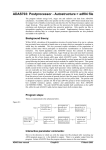
Interactive parameter comments:
The program uses parametric forms for zero density recombination, ionisation and
radiated power loss coefficients, type adf03, to prepare standard (unresolved, stage to
stage) iso-nuclear master files for a particular element of type adf11. The iso-nuclear
master files may be prepared over arbitrary ranges of electron temperature and
electron density.
The file selection window is shown below:
1
2
3
4
17
1.
Data root shows the full pathway to the appropriate data sub-directories.
Click the Central Data button to insert the default central ADAS pathway to
the correct data type. The appropriate ADAS data format for input to this
program is adf03 (‘atompars files’). Click the User Data button to insert the
pathway to your own data. Note that your data must be held in a similar file
structure to central ADAS, but with your identifier replacing the first adas, to
use this facility. The Data root can be edited directly. Click the Edit Path
Name button first to permit editing.
Available sub-directories are shown in the large file display window. Click
on a name to select it. The selected name appears in the smaller selection
window above the file display window. Then its sub-directories in turn are
displayed in the file display window. Ultimately the individual data-files are
presented for selection. Data-files all have the termination .dat.
A second file may be selected which specifies a spectral filtration to be
applied to the radiated power. Filter files are archived in format adf35 and
can be prepared and interrogated using the codes ADAS414 and ADAS415
respectively.
Once the data file is selected, the set of buttons at the bottom of the main
window become active. Clicking on the Browse Comments button displays
any information stored with the selected data-set. Clicking the Done button
moves you forward to the next window. Clicking the Cancel button takes
you back to the previous window
2.
3.
4.
The processing options window has the appearance shown below
1
2
5
4
3
1.
2.
At the top of the window, an arbitrary title may be given for the case being
processed.
The name of the data file under analysis and any filter file being used are
shown. The button Browse Comments allows display of the information
field section at the foot of the named atompars file, if it exists.
18
3.
4.
5.
The lower sub-windows allow the plasma electron temperature and electron
density for production of the output adf11 standard master files to be
specified. Select on the required temperature units. This choice determines
to the units used in the adjacent temperature range selection window.
Specify lower temperature limit, upper temperature limit and number of
temperatures in the editable boxes. ADAS408 then creates the temperature
grid equally spaced in the logarithm. Note that the output files in fact
contain the temperatures in eV (see the ADAS User Manual, appxb-11).
Similarly specify the electron density limits and number of grid points.
Enter the mass number for the actual isotope of the element required. For
information the element chemical symbol is displayed. Also, the mass
number of hydrogen isotope constituting the primary plasma species is
required.
The Exit to Menu icon is present in ADAS408. Clicking the Done button
causes the output options window to be displayed. Remember that Cancel
takes you back to the previous window.
The output options window is of restricted form. It only offers the option of an
output files. There is no output graph.
1. The adf11 iso-nuclear master file output comprises several. The template
shows the file naming structure
2. Collections of adf11 files are held by year number and element. Enter a two
digit year number for the output. Note that any two digits are acceptable and
‘fictitious’ years can be used for special collections if so desired. The
element name is inserted automatically from the atompars input file.
3. The filter name field of the template is only sensitised if a filter file has been
selected on input. The convention in the past was that in the simple cut-off
case, the filter name had the prefix ‘ev’ followed by the numerical value of
the cut-off energy in eV. In the true filter case (which was restricted to
beryllium/silicon, the filter name had the prefix ‘ft’ followed by the first two
significant figures of the beryllium and silicon thicknesses. The much
greater flexibility of the full Henke filter implementation is not encompassed
by the old convention. Filter names are at your own choice although central
ADAS will continue to have adf11 data following the old naming. Note also
that the output files can be placed in a directory of your choice rather than
entering the pass directory.
4. Click on the buttons for the output adf11 file classes you wish. The filtered
power classes are only sensitized if a filter file has been selected.
5. The standard line printer text output file summarising the options selected
for ADAS408 is available. The Replace and Default File Name buttons are
present for the text output file as usual.
6. The Exit to Menu icon is present in ADAS408. Clicking the Done button
causes the output options window to be displayed. Remember that Cancel
takes you back to the previous window.
19
1
2
3
4
5
6
Illustration:
There is no graphical display from this code.
Table 5.8a
20
*****************
RUN SUMMARY FOR PROGRAM GENERATING STANDARD
*******************
****************
ISONUCLEAR MASTER FILES FROM PARAMETRIC FORMS *******************
***************************** ADAS408 - DATE: 19.08.03 ******************************
INPUT PARAMETER FILE
: /home/adas/adas/adf03/atompars/atompars_mm#ar.dat
Output files:
/home/mog/pass/acd89_ar.pass
/home/mog/pass/scd89_ar.pass
/home/mog/pass/ccd89_ar.pass
/home/mog/pass/prb89_ar.fil_jet.pass
/home/mog/pass/plt89_ar.fil_jet.pass
/home/mog/pass/pls89_ar.pass
/home/mog/pass/prc89_ar.fil_jet.pass
/home/mog/pass/prb89_ar.pass
/home/mog/pass/plt89_ar.pass
/home/mog/pass/prc89_ar.pass
-------------------
IMPURITY INFORMATION:
--------------------ELEMENT SYMBOL
NUCLEAR CHARGE
LOWEST ION CHARGE
HIGHEST ION CHARGE
ATOMIC MASS NUMBER
-------------------
=
=
=
=
=
NEUTRAL DONOR INFORMATION:
-------------------------ELEMENT SYMBOL
=
NUCLEAR CHARGE
=
ATOMIC MASS NUMBER
=
ar
18
0
17
40.00
H
1
2.01
FILTER INFORMATION:
------------------Filter from : /home/adas/adas/adf35/jet_filter.dat
ELECTRON TEMPERATURE/DENSITY INFORMATION:
-----------------------------------------
NUMBER OF VALUES
MINIMUM VALUE
MAXIMUM VALUE
TEMPERATURE (EV)
---------------=
48
=
1.0000D+00
=
5.0000D+04
DENSITY (CM-3)
-------------26
1.0000D+10
1.0000D+15
(NOTE: EQUAL INTERVALS IN THE LOGARITHM ARE SET)
Notes:
21