1
GLOSSARY
Standard target object
Perpendicular operation
Reset (OFF)
Standard target object SPCC
Actuated (ON)
DT
Differential
travel
D Rated
sensing
distance
Return distance
Reference point
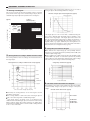
A target object that is used for measuring the sensing distance. Normally, this is a square iron plate (cold-rolled steel sheet, SPCC) of standard size. Generally, the size of the standard target object is the minimum target object size so that a fixed sensing distance can be
achieved. Accordingly, the proximity switch is actuated at approximately the rated sensing distance if the target object is larger than the standard target object and of the same material and thickness.
Proximity switch
Standard target object
Generally, the sensing distance of a proximity switch is measured
by this perpendicular actuation method.
Proximity switch
d
Parallel operation
Reset (OFF)
(Sensing distance)
Ex.: FL7M DC 2-wire shielded switch,
O.D. M8: Iron 8 x 8 mm, t=1 mm
d
t
(Differential travel)
Actuated (ON)
Standard target object SPCC
Reference axis
Reference point
Differential travel
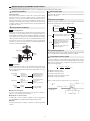
This is the difference between the distance (sensing distance) at
which a standard target object approaching perpendicular to the
sensing face actuates the proximity switch and the distance (reset
distance) which the standard target object must move away for the
switch to return to OFF. This is expressed as a percentage of the
sensing distance.
Proximity switch
OFF
Usable sensing distance
This is the distance to the target object from the sensing face at
which the target object can be stably detected when it approaches
from a direction that is parallel to the sensing face.
Normally, this is 70 to 80 % of the rated sensing distance.
Rated sensing distance
Usable sensing
distance
Note: Iron target of
standard target object
dimensions or more
Sensing
distance
Reset
distance
Rated sensing distance
This is the distance to the target object from the sensing face at
which the proximity switch is actuated when a standard target
object approaches in a direction that is perpendicular to the sensing
face.
ON
Target object
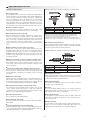
Expressed as the measured distance from the reference point when
the standard target objects moved parallel to the sensing face. This
distance depends on the moving path (distance from the reference
point), so it can be expressed as an operating point locus (sensing
area diagram).
Difference
travel
Ex.: FL7M DC 2-wire shielded switch,
O.D. M8: 15 % max. of sensing distance
Mutual interference
This refers to the state in which performance and characteristics
(e.g. sensing distance) are influenced when two or more switches
are positioned close to each other.
Off-state current
In the case of 2-wire proximity switches, a slight current flows to activate internal circuits even when output is OFF. This is referred to
as off-state current. Since off-state current is present, a voltage
equivalent to load resistance x off-state current is exerted on the
load even when the proximity switch is OFF. Note that this will
cause reset failure of the load if the off-state current exceeds the
load reset voltage.
Ex.: FL7M DC 2-wire shielded switch,
O.D. M8: 0.55 mA max.
Switching current
Sensing face
Target object
This refers to the minimum current required by the proximity switch
and the maximum current that the proximity switch can switch.
switching current
•TheMaximum
maximum current that is allowed to flow to the output circuit
when the proximity switch is ON. If the current is greater, the load
short-circuit protection circuit will be activated, or the proximity
switch will be damaged.
2