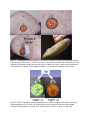
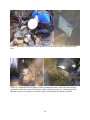
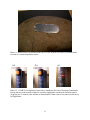
1
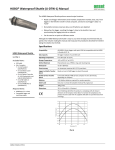
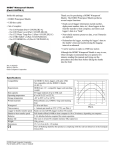
Users should consult the manual that accompanies the Onset Waterproof Shuttle and practice
using the TidbiT v2 and shuttle before taking them to the field.
Warning: do not change the shuttle’s batteries in the field as this will stop the shuttle’s clock and
will prevent further downloads. Refer to the user’s manual for more information.
Data Quality
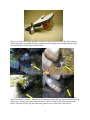
Field trial results suggest that sensors deployed with the Fox epoxy will easily withstand annual
floods if attachment sites on rocks are properly selected to shield sensors from bedload
movement. Based on our experience, it takes approximately 20 minutes to install a temperature
sensor once a suitable rock is located. The Fox epoxy worked well in the stream temperatures
tested (5°C – 20°C), but further tests should be conducted if the epoxy is used in warmer water
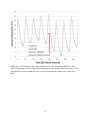
temperatures. Finally, temperature readings are not biased by direct attachment to large boulders
(possible heat conduction effect) and accurately reflect conditions in the surrounding stream
based on comparisons to control data (Graph 1). Additional details regarding the laboratory and
field trials used to develop the epoxy method will be published (Isaak and Horan, In review).
Please consult our stream temperature website for the latest version of this protocol as it is
periodically updated (http://www.fs.fed.us/rm/boise/AWAE/projects/stream_temperature.shtml).
References
Dunham, J. B., G. Chandler, B. E. Rieman, and D. Martin. 2005. Measuring stream temperature
with digital dataloggers: a user’s guide. General Technical Report RMRSGTR-150WWW.
U.S. Forest Service, Rocky Mountain Research Station, Fort Collins, Colorado, USA.
Dunham, J.B., A.E. Rosenberger, C.H. Luce, B.E. Rieman. 2007. Influences of Wildfire and
Channel Reorganization on Spatial and Temporal Variation in Stream Temperature and the
Distribution of Fish and Amphibians. Ecosystems: 10: 335-346.
Isaak, D.J., B.E. Rieman, and D. Horan. 2009. A watershed-scale bull trout monitoring protocol.
USDA Forest Service, Rocky Mountain Research Station, GTR-RMRS-224, Fort Collins,
CO.
Isaak, D.J., and D.L. Horan. In Review. An assessment of underwater epoxies for permanently
installing temperature sensors in mountain streams. North American Journal of Fisheries
Management.
Isaak, D.J., C. Luce, B.E. Rieman, D. Nagel, E. Peterson, D. Horan, S. Parkes, and G. Chandler.
2010. Effects of climate change and wildfires on stream temperatures and salmonid thermal
habitats across a mountain river network. Ecological Applications 20:1350-1371.
Kaushal, S.S., G.E. Likens, N.A. Jaworski, M.L. Pace, A.M. Sides, D. Seekell, K.T. Belt, D.H.
Secor, and R.L. Wingate. 2010. Rising stream and river temperatures in the United States.
Frontiers in Ecology and the Environment doi:10.1890/090037.
Mohseni, O., T.R. Erickson, and H.G. Stefan. 1999. Sensitivity of stream temperatures in the
United States to air temperatures projected under a global warming scenario. Water
Resources Research 35:3723-3733.
Rieman, B.E., and D.J. Isaak. In Press. Climate change, aquatic ecosystems and fishes in the
Rocky Mountain West: implications and alternatives for management. USDA Forest Service,
Rocky Mountain Research Station, GTR-RMRS-xxx, Fort Collins, CO.
5