1
62
A day in the life
Theresa Cameron gets the
best out of any situation
At 6.30 am on a weekday, I may be
in my pyjamas working at my desk
or dressed and ready to board an
international train at Gare du Nord. As
a contractor, both these scenarios are
part of the course for me; the routine
of a daily commute into a local office
being the exception rather than the
rule. This semi-nomadic lifestyle comes
from one of my selection criteria for
an onsite contract: is there a direct
train? From Paris, I can get to Brussels
in an hour and a half or be in a London
office by 9 am. If I include planes in the
equation, many other European cities
are easily accessible.
The benefits of remote work
It’s rare for me to work locally in
the Paris region although I speak
French (and German). Most French
documentation teams don’t have
editors, so I decided to write exclusively
in English. When I moved to France 12
years’ ago, there was a huge demand for
Anglophone writers. Now I can indulge
a passion for visiting other countries or
simply stay at home and work remotely.
If I’m working for a client in a different
time zone, then home is best. Editing
for a Chinese client who is eight hours
ahead of GMT means an early start to
get marked-up documentation to them
by their end of day. I aim to complete
the work the night before but I like to
check it after a break, hence the pyjama
scenario! It helps to be online early too,
just in case there are urgent additional
requests. The customer is, after all, king.
The home office also allows me the
flexibility to follow up on ISTC Council
activities. Apart from general Council
issues, in my role as International
Communicator Spring 2012
Manager I try to respond to any
international queries and requests
sent to the ISTC office or directly to
me. Pointing a member to a LinkedIn
group for work opportunities abroad,
distributing announcements from
overseas associations, or perhaps
connecting a potential sponsor with
organisers of a European event are all
examples of such queries. I am also the
representative for our European partner
associations in TCeurope. If a European
issue emerges through an email thread,
I pick up the phone and talk to my
French counterpart. It’s not quite
international diplomacy but it does
help to discuss and compare points of
view and negotiate a joint approach,
especially as the association delegates
only meet in person once a year.
The benefits of association membership
Apart from the technical topics, I’ve
also found the ISTC discussion list
to be useful for work opportunities.
As most contract offers on the list
are away from home for me, another
of my selection criteria is: do I know
anyone there? Having friends in other
countries makes foreign contracts
much easier to accept.
It is due entirely to professional
membership that I can rent a room in
Brussels, for example, from a friend
who I met through an association.
There are enough things to think about
when travelling so a ready address with
all the trimmings is a huge benefit. I
can get the low-down on everything
that’s going on, attend association
events, and have an interpreter on
hand to explain the unfathomable local
‘logic’ – the regional habits that are
not mentioned in travel guides. When
working abroad for example, it can be
life-saving to have an expat friend who
can tell me whether cars will stop for
pedestrians at zebra crossings – or not!
The onsite scenario
Writing the content for documentation
on a foreign site is much the same
everywhere, and although the tools
may vary, the user interface is
generally in English. Working with
US, UK or another variety of English
doesn’t pose a problem either – even if
some oddities such as ‘parameterize’
and ‘zeroize’ make me cringe.
Applying style guides is another
matter, especially when updating
existing documentation that has clearly
been written by different authors
using a variety of styles. Contracts
tend not to include the time to edit for
consistency and in the least satisfying
scenario, I apply whatever styles I have
been given to my text then shut my
eyes and hope for the best.
It’s in small companies when there
are no guidelines that I have to hope
that the marketing department will
be able to supply a clean basic style
sheet. If an existing template has been
used by engineers and developers,
they have the tendency to ‘improve’ it
with their own preferences, effectively
transforming Word into Weird.
The back-up scenario
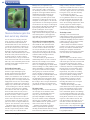
Although I can be mesmerised
temporarily by flocks of green parrots
and garden birds gorging themselves
on fatballs dangling from the window
railings, the back‑up scenario usually
kicks in during waiting times.
This is when I succumb to another
passion. I use the time to research the
history of technical communication,
hunting for examples of unusual
instructional texts from the past that I
can write about for Communicator.
The ideal scenario
Most recently I was asked to write a
report for a company that I had worked
with in the past. The first contract had
been on the customer’s site, which
required a weekly commute from Paris
to Euston, and later to Angel Islington.
Having spent several months onsite,
I already knew everyone – and more
importantly, they knew me. During
the research for the report, I worked
mostly from home, sending email
queries directly to the relevant expert
and invariably receiving a speedy
response. Occasional face-to-face
meetings in London were set up for
roundtable discussions.
Outside the meetings, the office
visits allowed me to have quick ad hoc
chats with peripheral people on the
project as well as hear all the latest
news and admire photos of weddings
or new family members. For each visit,
the team organiser ensured that I had a
desk, phone, internet access, and an
espresso coffee when I arrived. The
only downside was keeping an eye on
the clock to make sure that I left in
time to catch an evening Eurostar train
back to Paris. A day of pure bliss. C
Theresa Cameron MA FISTC
E: engelix@wanadoo.fr