1
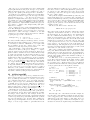
The category of ρ-types includes monotypes, higher-rank
polymorphic functions, and pc pt, the type of a pointcut,
which in turn binds a list of type variables in a pair of
polytypes. We explain pointcut types in more detail later.
In addition to type variables, a, simple base types like Unit,
String, Int, and function types, the monotypes includes
tuple and list types, (t1 , . . . ,tn ) and [t] respectively, type
application for higher-kinded monotypes, and type constructors T. Tuple types are actually syntactic sugar for an infinite
number of type constructors TUPLEn for n greater than two.
Type variables may only instantiated with monotypes; it is
not possible to construct a list of higher-rank polymorphic
functions, for example.
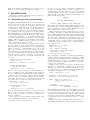
Type constructors can be defined using datatype declarations. The datatype declaration is essentially the same as in
ml and Haskell, with the exception of support for gadts [23],
and is used to define a new type constructor, T, via data
constructors. For example, lists in Aspectml are definable
by giving the types of the constructors.
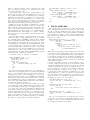
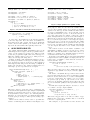
datatype List = [] : <a> List a
| :: : <a> a -> List a -> List a
Note that, as in this example, it is always possible to elide the
kind annotation when defining a type constructor because
it can always be inferred. Furthermore, we require that
the programmer provide the complete types of the data
constructors because Aspectml provides gadts.
The term language of Aspectml include variables x, term
constructors C, unit (), integers i, strings " . . . ", tuples,
syntactic sugar for lists, anonymous functions, function application and let declarations. New recursive functions may
be defined in declarations. These functions may be polymorphic, and they may or may not be annotated with their
argument and result types. Furthermore, if the programmer
wishes to refer to type parameters within these annotations
of the body of the function, they must specify a binding
set of type variables <a:k>. When the type annotations
are omitted, Aspectml may infer them. However, inference
is Aspectml is limited to monotypes if no annotations are
provided. Aspectml does not yet support advice for curried
functions, so the syntax for recursive function definitions
only allows a single argument. However, curried functions
may still be written by using anonymous functions.
2.1
AOP in AspectML
To support aop, Aspectml provides pointcuts and advice.
Advice in Aspectml is second-class and includes two parts:
the body, which specifies what to do, and the pointcut designator, which specifies when to do it. A pointcut designator
has two parts, a trigger time, which may be before, after,
or around, and a pointcut proper, which is a set of function
names and an optional pointcut type annotation. The set of
function names may be written out verbatim as #f#, or, to
indicate all functions, the any pointcut might be used.
Informally, the pointcut type, (<a> s1 ~> s2 ), describes
the i/o behavior of a pointcut. In Aspectml, pointcuts are
sets of functions, and s1 and s2 approximate the domains
and ranges of those functions. For example, if there are
functions f and g with types String -> String and String
-> Unit respectively, the pointcut #f,g# has the pointcut
type pc (<a> String ~> a). Because their domains are
equal, the type String suffices. However, they have different
ranges, so we use a type variable to generalize them both.
Any approximation is a valid type for a pointcut, so it would
have also been fine to annotate #f,g# with the pointcut type
pc (<a b> a ~> b). This latter type is the most general
pointcut type, and can be the type for any pointcut, and is
the type of any pointcut.
The pointcut designator before #f# represents the point
in time immediately before executing a call to the function f.
Likewise after #f# represents the point in time immediately
after execution. The pointcut designator around #f# wraps
around the execution of a call to the function f—the advice
triggered by the pointcut controls whether the function call
actually executes or not.
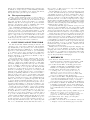
The most basic kind of advice has the form:
advice tm e1 (p1 ,p2 ,p2 ) = e2
Here, tm e1 is the pointcut designator. When the pointcut
designator dictates that it is time to execute the advice,
the first pattern, p1 , is bound either to the argument (in
the case of before and around advice) or to the result of
function execution (in the case of after advice). The second
pattern, p2 , is matched against the current call stack. Stack
analysis is a novel feature of Aspectml, but it is orthogonal
to the expressiveness of tdp, so we do not discuss it in this
paper. Refer to our other papers for more information on
stack analysis [5]. The last pattern, p3 , is matched against
metadata describing the function that has been called, such
as its name or location in the source text.
Since advice exchanges data with the designated control
flow point, before and after advice must return a value
with the same type as the first pattern p1 . For around advice,
p1 has the type of the argument of the triggering function,
and the advice must return a value with the result type of
the triggering function.
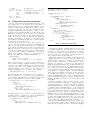
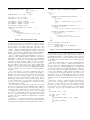
A common use of aop to add tracing information to functions. These statements print out information when certain
functions are called or return. For example, we can advise
the program below to display messages before any function
is called and after the functions f and g return. The trace
of the program is shown on the right in comments.
(* code *)
fun f x = x + 1
fun g x = if x then f 1
else f 0
fun h _ = False
(*
(*
(*
(*
(*
(*
(*
Output trace
entering g
entering f
leaving f => 2
leaving g => 2
entering h
*)
*)
*)
*)
*)
*)
*)
(* advice *)
advice before any (arg, _, info) =
(print ("entering " ^ (getFunName info) ^ "\n");
arg)
advice after #f,g# (arg, _, info) =
(print ("leaving " ^ (getFunName info) ^
" => " ^ (intToString arg) ^ "\n");
arg)
val _ = h (g True)
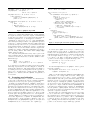
Even though some of the functions in this example are
monomorphic, polymorphism is essential. Because the advice
can be triggered by any of these functions and they have
different types, the advice must be polymorphic. Moreover,
since the argument types of functions f and g have no type
structure in common, the argument arg of the before advice