1
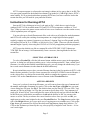
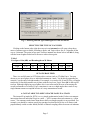
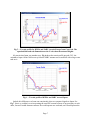
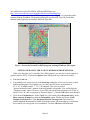
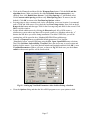
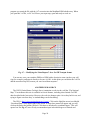
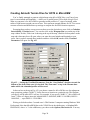
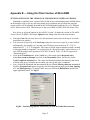
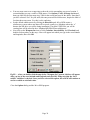
Fig 2—Entering antenna types and heights for each terrain file. SELECTING THE TYPE OF YAGI USED Clicking on the button at the right down arrow in an Antenna box will open a drop-down menu of antenna types available, including a dipole, and Yagis with as few as 2 elements all the way to 8 elements. The gains in free space for these antennas are shown below in Table 1, along with the boom lengths needed on 20 meters to achieve these gains. Table 1 Free-Space Gain (dBi) and Boomlengths on 20 Meters Antenna Gain 20-m Boom Dipole 2.15 2-Ele. 5.5 8' 3-Ele. 7.0 16' 4-Ele. 8.5 26' 5-Ele. 9.5 40' 6-Ele. 11.0 60' 8-Ele. 12.0 80' OUT-OF-PHASE FEED There is a useful feature in HFTA that earlier versions (such as YT) didn’t have. You may choose to use out-of-phase drive to individual antennas in a stack. You do this by appending an asterisk (*) to the end of a height number. For example, in a stack at 90, 60 and 30 feet, you might run the top 90-foot high antenna out-of-phase with the two lower Yagis. Enter 90* in the top left text box. Although employing out-of-phase drive is not often useful in terms of increasing the overall performance of a stack of Yagis, sometimes it can cover high angles that a stack or any single antenna cannot accomplish because of a steep mountainous terrain. A CAVEAT ABOUT CLOSELY SPACED YAGIS IN A STACK The internal Yagi model in HFTA is a very simple mathematical model. It does not compute interactions between individual Yagis in a stack — HFTA assumes that each antenna is a “point source.” For antennas stacked more than about a half wavelength apart this is not a problem. For example, you should be cautious specifying spacings less than about 20 feet on 20 meters (and proportionately scaled on other bands) because of mutual-coupling effects between real antennas. Page 3