1
INTERNATIONAL JOURNAL OF CIRCUITS, SYSTEMS AND SIGNAL PROCESSING
noise variance. Selecting one indicates that the noise is white
with unit variance. Selecting multiple levels indicates that the
noise does not have to be white and that the virtual instrument
estimates the noise standard deviation at each level
independently. Option for approximation — specifies the
operation for the approximation coefficients from the wavelet
decomposition. The default is none, which indicates that the
virtual instrument keeps the approximation coefficients
unchanged. If you select threshold, the virtual instrument
applies the same thresholding operation to the approximation
coefficients. If you select detrend, the virtual instrument sets
the approximation coefficients to 0.
In the last few years [7], [8], wavelets have emerged as a
powerful tool for extracting signals from noisy data. For the
case of Gaussian white noise, the signal extraction problem
can be stated as follows: we determine the true values of a
signal Sz, given set noisy observations
The data source can be from terminal or from file. From
terminal specifies that the virtual instrument reads data from
the block diagram input. From file specifies that the virtual
instrument reads data from a file. The virtual instrument can
read data from waveform, WAV, or TXT files. The virtual
instrument processes the data from WAV files as a waveform
data type. The valid format of a TXT data file is a file that
contains only a 1D real array, a 2×m real matrix, or an m×2
real matrix. The virtual instrument processes the 1D real array
from TXT data files as a real data type. The virtual instrument
processes the 2×m real matrix or the m×2 real matrix from a
TXT data file as a complex data type. The virtual instrument
treats the first row or column as the real part of the data and
treats the second row or column as the imaginary part of the
data.
File Path Configuration contains the following options: File
path — Specifies and displays the full path to the file from
which we want to read data; Ask user to choose a file each
time this VI runs — Displays a dialog box that prompts users
to select a file each time the virtual instrument runs. This
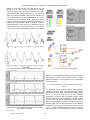
Express Virtual Instrument displays the original signal and the
signal after denoising. The transform settings contain the
following options: Transform type — Specifies the use of the
discrete wavelet transform or undecimated wavelet transform
to denoise the signal. Wavelet — specifies the wavelet type to
use for the discrete wavelet analysis. The default is db02. The
options include two types: orthogonal (Haar, Daubechies
(dbxx), Coiflets (coifx), Symmlets (symx)) and biorthogonal
(FBI, Biorthogonal (biorx_x)), where x indicates the order of
the wavelet. The higher the order, the smoother the wavelet.
The orthogonal wavelets are not redundant and are suitable for
signal or image denoising and compression. The biorthogonal
wavelets usually have the linear phase property and are
suitable for signal or image feature extraction. Threshold
settings contain the following options: Soft threshold —
specifies to use the soft thresholding method. The default is to
use the soft thresholding method. If you remove the
checkmark from the Soft threshold checkbox, the virtual
instrument uses the hard thresholding method. Thresholding
rule —specifies the threshold selection rules. The default is
SURE, which indicates that the virtual instrument uses the
principle of Stein's Unbiased Risk Estimate (SURE) to
estimate the threshold. If you select Hybrid, the virtual
instrument finds a compromise between the SURE method
and the Universal Method. When the signal-to-noise ratio of
the noisy signal is very low, the virtual instrument uses the
Universal Method to estimate the threshold. If you select
Universal, the virtual instrument sets the threshold to sqrt
(2×log (Ls)), where Ls is the signal length. If you select
Minimax, the virtual instrument uses the Minimax Principle to
estimate the threshold. Rescaling method — Specifies the
method to use to estimate the noise variance at each level. The
default is single level, which indicates that the noise is white
and that the virtual instrument estimates the noise standard
deviation from the wavelet coefficients at the first level. The
virtual instrument uses the noise variance to rescale the
threshold. Therefore, you can update the thresholds with the
Issue 4, Volume 1, 2007
S iz = S i + σ ⋅ z i , i = 0, … , n − 1,
where S iz = S z (t i ) and
(4)
S i = S (t i ) at times t i = i n , σ is
the standard deviation of the noise, and z i are random
variables according to N (0, 1). In the wavelet domainψ , we
can rewrite:
( )
(
)
Wψ S iz = Wψ (S i + σS i ) = Wψ S i + σ Wψ zi .
(5)
V. CONCLUSION
As the performance to cost ratios for computers continues to
grow, there will be a great need for computer based
acquisition-analysis systems. These systems can be an
inexpensive replacement for the costly stand-alone, signal
specific, systems currently in use. The components necessary
for a LabVIEW based acquisition and analysis system are
inexpensive and readily available. The experience necessary
to program this type of system in LabVIEW is small and the
numbers of libraries available from National Instruments is
growing. These developments show that a computer based
system using LabVIEW can be an efficient alternative to stand
alone equipment and as the speed and reliability of the
computer increases, there will be more and more of these
systems available.
REFERENCES
[1]
[2]
[3]
[4]
[5]
325
J. Olansen, E. Rosow, Virtual Bio-Instrumentation, Biomedical, Clinical
and Healthcare applications in LabVIEW, Publishing House Prentice
Hall PTR, 2002.
R. M. Rangayyan, Biomedical Signal Analysis, Wiley-Intersciene, John
Wiley & SONS, INC., 2002.
A. Aldroubi, M. Unser, Wavelets in Medicine and Biology, Publishing
House CRC Press, 1996.
M. Unser, A. Aldroubi and M. Eden, “ On the asymptotic convergence
of B-spline wavelets to Gabor functions”, IEEE Trans. Inform. Theory
38 (2), 864-872, 1992.
C. Li, C. Zheng, C. Tai, “Detection of ECG characteristic points using
wavelet transforms” , IEEE Trans. on Biomed. Eng., pp: 21-28, 1995.