1
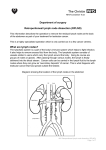
away with your urine. If this does occur, it is very likely that you will be sterile. This does not always happen and you urologist may be able to tell you if it is likely in your case. If you have not already done so, it may be possible for you to store semen as a precaution and you should discuss this with your urologist before the procedure. You will usually be admitted to hospital on the same day as your surgery. You will normally receive an appointment for a “pre-assessment” to assess your general fitness, to screen you for MRSA and to do some baseline investigations. Once you have been admitted, you will be seen by members of the medical team which may include the consultant, specialist registrar, house officer and your named nurse. On the day before your operation, you will only be allowed to drink clear fluids such as water, squash, black tea or coffee. You may also be given a laxative to clear your bowel. Immediately before the operation, the anaesthetist may give you a premedication which will make you dry-mouthed and pleasantly sleepy. You will be given an injection of a drug called Clexane under your skin. Together with elasticated stockings provided by the ward, this will help to prevent venous thrombosis (clots in your legs) Please tell your surgeon (before your surgery) if you have any of the following: An artificial heart valve A coronary artery stent A heart pacemaker or defibrillator An artificial joint An artificial blood-vessel graft A neurosurgical shunt Any other implanted foreign body A regular prescription for warfarin, aspirin or clopidogrel (Plavix®) A previous or current MRSA infection A high risk of variant-CJD (if you have had a corneal transplant, a neurosurgical dural transplant or injections of human-derived growth hormone). When you are admitted to hospital, you will be asked to sign the second part of your operation consent form giving permission for your operation to take place, showing you understand what is to be done and confirming that you want to go ahead. Make sure that you are given the opportunity to discuss any concerns and to ask any questions you may still have before signing the form. What happens during the procedure? A full general anaesthetic is normally used and you will be asleep throughout the procedure. You will usually be given an injection of antibiotics before the procedure, after you have been checked for any allergies. The anaesthetist may also use an epidural or spinal anaesthetic to reduce the level of pain afterwards. The surgeon will make a long incision will be made in your tummy (pictured below) to allow the necessary lymph nodes to be removed. RETROPERITONEAL EXCISION OF ABDOMINAL LYMPH NODES Page 2