1
G
SAFETY WARNINGS
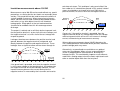
Safety warnings must be observed during use:
• The circuit under test must be switched off, de-energised,
isolated and checked to be safe before insulation test
connections are made. Make sure the circuit is not reenergised
whilst the instrument is connected.
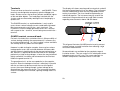
• Only 15 kV rated Megger test leads with plug inserts of 75 mm
must only be used on the MIT1525. Lead integrity can be
verified by momentarily shorting clips together at the lowest test
voltage range.
• Circuit terminals must not be touched during an insulation test
or before suitable grounding of the unit under test is in place in
line with safe working practices.
• The functional earth terminal on MIT1525 must be connected to
provide a resistance path to ground, or a uni-potential bonding
point.
• After completing a test, capacitive circuits must be completely
discharged before disconnecting the test leads. Capacitive
charges can be lethal.
• Tested items must be firmly shorted out with a shorting link, after
discharge, until required for use. This is to guard against any
stored dielectric absorption charge subsequently being released
thereby raising the voltage to potentially dangerous levels.
• The voltage indicator and automatic discharge features must be
regarded as additional safety features and not a substitute for
normal safe working practice.
• It is rare, but in certain circumstances, breakdown of the circuit
under test may cause the instrument to terminate the test in an
uncontrolled manner, possibly causing a loss of display while the
circuit remains energised. In this event, the unit must be turned
off and the circuit discharged manually.
• Test leads, including crocodile clips, must be in good order,
clean and with no broken or cracked insulation.
• The instrument must not be used if any part of it is damaged.
• Insulation testing in wet conditions might be hazardous. It is
recommended that this instrument is not used in these
circumstances. If this is unavoidable, the user must take all
necessary precautions.
• This instrument is not intrinsically safe and must not be used in
hazardous atmospheres.
• If this equipment is used in a manner not specified by the
manufacturer, the protection provided by the equipment may be
impaired.
• Switch the instrument OFF, and disconnect any AC source,
measurement leads, and all other equipment before opening the
case to change the battery. The instrument must not be
operated with the case open. DANGER! Hazardous voltages are
exposed with an AC source connected and the case open.
BATTERY WARNINGS
• Do not disassemble or modify the battery. The battery contains
safety and protection devices which, if damaged, may cause the
battery to generate heat, rupture or ignite.
• Never heat the battery in a fire or otherwise.
• Do not pierce or damage the battery in any way
• Do not subject the battery to strong impacts/shocks.
• Do not expose the battery to water, salt water or allow the
battery to get wet.
• Never short circuit, reverse polarity or disassemble the battery
pack.
• In the event of a battery cell leaking, do not allow the liquid to
come into contact with the skin or eyes. If contact has been
made, wash the affected area with copious amounts of water
and seek medical advice.
• Keep cells and batteries out of reach of children
• Seek medical advice if a cell or battery has been swallowed.
• Do not leave a battery on prolonged charge when not in use.
• Retain the original product literature for future reference.
NOTE:
THE INSTRUMENT MUST ONLY BE OPERATED BY
SUITABLY TRAINED AND COMPETENT PERSONS
Users of this equipment and/or their employers are reminded
that National Health and Safety Legislation requires them to
carry out valid risk assessments of all electrical work so as to
identify potential sources of electrical danger and risk of
electrical injury such as inadvertent short circuits.
2