1
2. Related Work
A number of systems have been created for controlling appliances. Commercial products have been
available for years that allow limited control for certain electronic appliances, and recently companies
have begun forming standards groups to agree on new solutions for controlling appliances, such as HAVi
[10], JINI [32], and UPnP [36]. Another standards group, INCITS/V2 [37], was formed to examine
standardizing appliance control in order to benefit people with handicaps. There have also been several
research projects that have explored this area such as Xweb [23], ICrafter [26], and Supple [41]. At the
end of this section I also survey past and present work on automatic interface generation and the use of
various models to support the generation process.
2.1 Existing Commercial Products
For years many companies have been selling so-called “universal remote controls,” which replace the
standard remote controls for televisions, VCRs, and stereos with a single remote control unit. A one-way
infrared protocol is used to issue commands to the appliances. Typical universal remote control products
have physical buttons that correspond to the most common subset of features found on the appliances that
the universal remote can control. For televisions this is limited to channel up and down, volume up and
down, a number pad for manually entering channels, and a power button. For example, my mother has a
universal remote for her television and VCR, but must use the original remote for the TV in order to
access the television’s configuration menus. Some universal remotes avoid this problem with a teaching
feature, which allows the user to assign buttons on the universal remote to a particular code that is
recorded from the original remote control.
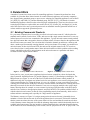
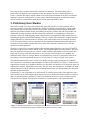
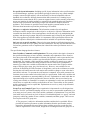
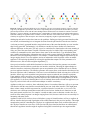
Figure 1. A Philips Pronto remote control device.
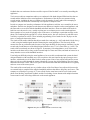
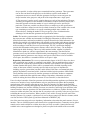
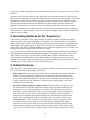
Figure 2. A Harmony remote control device.
In the past few years, several more complicated universal remote controls have been developed that
deserve mention: the Philips Pronto [25] and the Harmony remote [13] from Intrigue technologies. The
Philips Pronto (see Figure 1) was one of the first LCD-based universal remote control products. In
addition to being able to program new infrared codes for new appliances, users can also design the panels
of the controls that they use. Using the Pronto, it is easy, for example, to create a specialized screen for
watching movies that has the DVD player and stereo volume controls, and another for watching television
that only has controls for the cable box channels. Users can even associate multiple codes with a single
button, allowing them, for example, to create a macro for playing a DVD that turns on the DVD player
and television, switches to the appropriate channel, and plays the DVD. The problem with the Pronto, as
with the other universal remotes, is that all of the programming must be done manually, which can be a
tedious and time-consuming task, especially for a large number of appliances.
The Harmony remote (see Figure 2) is unique among universal remotes because it internally tries to
maintain a record of the current state for all of the appliances that it can control. This has the limitation
that the remote must know the state of the system when it is first used and that all control must be done
via the Harmony remote afterwards, but it has the advantage that remote can hide functionality that is not
available in the current state. The user interface is further simplified using a task-based interface shown
on the small LCD screen which displays a list of tasks, such as “play movie in VCR” or “play DVD.” The
5