1
RAF SUPERNOVA USER MANUAL - ENGLISH
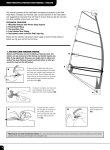
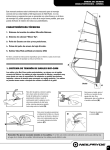
2. HEAD FITTING When used with the recommended mast, the
Neil Pryde fixed length head fitting offers a very clean and aerodynamic
profile, with no unnecessary and heavy webbing flying around. By
following the printed specifications at the tack of the sail, you will obtain
the best tuning for your sail. However, in some cases (different length
mast or different extension system), you may need to use the adjustable
strap that is supplied with your sail (in the pocket of the sail bag).
Remove the male plug (A) from the webbing (B) that is sewn into the
luff pocket. Take the adjustable strap (C) and loop it through the
webbing (B) and the male plug (A), and position the buckle behind
the mast. Adjust to desired length.
3
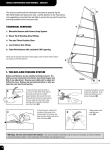
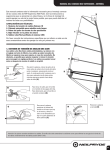
3. TWO POSITION CLEW Select the clew
ring that’s best suited to your requirements. Most
riders like the boom to be roughly perpendicular to
the mast, so start by setting the clew according to
your preferred boom height. Many riders prefer a
higher clew position in onshore conditions where
putting the rig forward helps in staying up wind as
well as in making backside maneuvers easier. Try a
lower clew ring in side shore, down-the-line conditions for a softer leech and a more powerful
bottom turn.
2
A
C
B
4
A
4. LOW FRICTION TACK
FITTING The Low Friction Tack Fitting
D
must be rigged properly to ensure
optimum downhauling efficiency. Always
rig the tack fitting according to the
diagram.
B
C
CHOOSING THE RIGHT MAST
A NOTE ON RIG DIMENSIONS
Every Neil Pryde sail is designed around a specific
recommended mast. To get the optimum performance from
your Neil Pryde sails, use the recommended mast. In many
cases an alternative mast is specified and this will also
provide good performance. For a lighter and more responsive
feel, you can choose to use the upgrade masts which are
specified.
The rig dimensions printed on the tack of all Neil Pryde
collection sails show the following information:
■ Base setting This is the number at which you should set
the ring on your Neil Pryde aluminum or carbon mast base.
Rigged on the correct mast and with a Neil Pryde mast base,
you will be able to perfectly downhaul your sail by following
the printed instructions at the tack of the sail.
■ Boom dimensions are stated at the best average tuned
dimensions plus or minus 1 cm. This is measured from the
forward edge of the mast (at the center of the boom cut out)
to the sail clew between the eyelets.
These figures are intended as a guide to proper sail trim and,
depending on the rig components you use, may not always
correspond perfectly to the settings which are the best for you.
RIGGING
A. Set your boom and mast base to the dimensions printed near the
tack. The sail is designed to be perfectly trimmed on the correct mast at
the recommended settings. For sails with adjustable head fittings, set
the webbing to the specified dimensions.
B. Check that all the battens are fully inserted into their pockets. The
battens are pre-tensioned at the factory and should require very little, if
any adjustment.
C. Insert the mast into the luff pocket working the sail down the mast a
bit at a time. When you have the mast almost all the way in, use the
tack handle to help pull the remaining distance to the mast base.
D. Thread the downhaul line according to the instructions and partially
tension the luff using the low friction tack fitting.
E. Attach the boom to the mast,
allowing space above it in the
cut-out so that the sail can be
fully downhauled later.
F. Downhaul the sail to
approximately 1 cm above the
cleat base as shown in diagram.
Fine-tune around this position. A
small sticker has been provided
with your sail which you can
wrap around your mast base and
use as a reference when you find
your best tuning. All 1998 Neil
Pryde mast bases already carry this trim zone. When in the correct
tuning range, the tack pulley will be as shown.
G. If necessary, re-tension the battens until wrinkles at the batten
pockets disappear. Be sure not to over-tension the battens.
H. Adjust the outhaul to the recommended dimensions and make the
boom length so the clew is within two centimeters of the boom end.
Use a tape measure to ensure accuracy and repeatability of the
settings.
I. To ensure correct tuning for your specific sail, please consult the trim
instructions that follow:
RIGGING TIPS
Pure RAF sails have no cams, so putting the mast into the luff pocket is
easy. Grab the sail by using the handle located inside the fairing. Our
MPR model has one intercam, but putting the mast into the luffpocket
is almost as easy as on RAF sails. Just make sure that the Intercam is
properly seated on the mast.
DE-RIGGING
A. Be sure that the tack fairing is clear of the mast base rings and
other rig components.
B. Carefully ease the outhaul until it is completely loose.
Remove the boom.
C. Carefully release the downhaul a little at a time. Remove the mast.
3