1
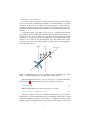
speed and wind model is used, neglecting the influence of lateral drift (the drift angle
is the angle between the longitudinal axis of an aircraft and its path relative to the
ground) on the along-track ground speed. With this approximation, which is justified
for aircraft flying at high speeds, the number of unknown variables can be considerably
reduced and the model can be linearized.
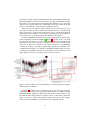
We also propose an interactive semi-automatic process, where the least squares
computation is driven by the user who selects the input data and validates the results
through a visual interface.
The remainder of the paper is organized as follows: section 2 details the related
works on trajectory exploration and wind extraction, while section 3 introduces the
principles of wind extraction from a dataset of aircraft trajectories. The dataset itself is
described in section 4. The issues that were raised during some preliminary tests of the
automatic extraction method are detailed in section 5. The interactive extraction procedure mixing the least squares algorithm and user filtering and adjustments is presented
in section 6. Section 7 shows how the wind dynamics can be extracted and displayed
in order to help the user to select time windows when filtering the data. Finally, in section 8, we visually compare our results with Météo-France data. We also discuss the
confidence intervals of the least squares method and give some numerical results on the
comparison with the Météo-France wind data and the wind computed from downlinked
aircraft data. Section 9 concludes the paper and gives some perspectives about further
improvements and possible applications of our method.
2. Related work
2.1. Trajectory exploration
The data-flow model in [5] is widely used to perform data exploration. In this
paper, we also use this data flow model to transform raw data (i.e. aircraft records) into
visualization with a sequence of transformation steps.
There is a rich bibliography on trajectory analysis in information visualization, in
particular on direct manipulation to filter and extract relevant aircraft information [6, 7],
density map computation to discover boat trajectory interactions [8], aircraft trajectory
schematization [9], trajectory bundling [10], Visual Analytics [11], knowledge discovery in databases [12, 13], geocomputations [14], moving object databases [15], and
detection of landing areas [16]. However, none of these previous works tried to extract
wind parameters from trajectories.
2.2. Wind extraction
De Haan and Stoffelen [17] show that high resolution wind and temperature observations can be obtained using on-board measurements made by aircraft and transmitted
through the data-link capabilities of the Enhanced Mode-S radars (these data will be
detailed in the following). They also show how these measurements can be used as
input to meteorological models to improve the short-term and small-scale prediction of
wind and temperature. These are significant improvements when compared with the
current weather forecasts used in Air Traffic Control (ATC), and they will probably
benefit ATC operations in the future.
3